
Four hundred dollars. That’s the gap between these two devices. And the gap is the whole story.
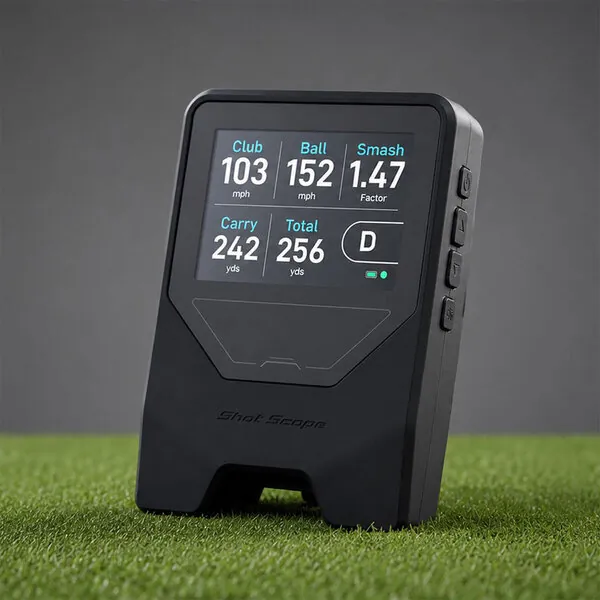
The Shot Scope LM1 is $199. It gives you five numbers on a screen. No simulator, no spin, no course play. It’s a practice tool.
The Blue Tees Rainmaker is $599. It gives you twenty-plus numbers, connects to GSPro and E6 Connect, and works as a real simulator input device. It’s a sim launch monitor that happens to be cheap.
These aren’t competitors. They’re two different products that happen to both be called “budget launch monitors.” The question isn’t which is better. The question is which one matches what you’re actually trying to do.
The Spec Sheet
| Shot Scope LM1 | Blue Tees Rainmaker | |
|---|---|---|
| Price | $199 | $599 |
| Technology | Doppler radar | Doppler radar |
| Display | 3.5“ color | 4.3“ TFT LCD |
| Metrics | 5 (ball speed, club speed, smash, carry, total) | 20+ (full ball + club data) |
| Spin rate | No | Yes |
| Launch angle | No | Yes |
| Club path | No | Yes |
| Simulator software | None | GSPro, E6 Connect |
| Subscription required | No | No (premium app tier optional) |
| Battery | 5+ hours | 7 hours |
| Water resistance | IPX3 | IPX4 |
| Phone required | No | No |
| Weight | 300g | ~720g |
| Indoor ball flight needed | Works but less accurate outdoors | 10-14 feet recommended |
Read that table carefully. The LM1 and the Rainmaker use the same core technology — Doppler radar — but the Rainmaker does four times as much with it.
The LM1 Case
The LM1 exists for one person: the golfer who wants to know their real yardages and doesn’t want to spend more than $200.
That’s a real person. That’s most golfers, actually. The guy who hits his 7-iron at the range and thinks “that felt good, I think that was 160” but has no way to verify. The woman doing speed training with SuperSpeed sticks who wants to track clubhead speed without buying a $600 device. The player who wants a pocket-sized gadget that lives in their golf bag and works at any range, no phone required.
For that person, the LM1 is perfect. Five metrics. Instant display. No subscription. $199. It’s the cheapest real ball data you can buy, and it doesn’t pretend to be anything else.
The LM1 is also the cheapest possible “should I even care about launch monitor data?” test. Buy it. Use it for a month. If you find yourself obsessively checking your smash factor and wanting to know your spin rate, you’ve learned that you’re the kind of golfer who’ll get value from a real device. Upgrade to the Rainmaker or a Garmin R10. If you use it twice and forget it exists, you just saved yourself $400-$2,500 on a device you wouldn’t have used.
The Rainmaker Case
The Rainmaker exists for a different person: the golfer who wants to play virtual golf in their house and $599 is their ceiling.
This is the person who’s been lurking on r/GolfSimulator, who’s read the cost guide and knows the sweet spot is $2,500, but whose actual budget is $1,000 and a dream. The Rainmaker is how you get there.
At $599 with GSPro and E6 Connect compatibility, the Rainmaker is a full simulator input device. You pair it with a $200 net, a $100 hitting mat, and a laptop you already own, and you’re playing virtual Pebble Beach for under $1,000. That’s the budget sim build that actually works.
The Rainmaker gives you spin rate, launch angle, club path, attack angle — all the metrics that simulator software needs to render a realistic ball flight. The LM1 can’t do this. It doesn’t measure spin. It doesn’t connect to any sim platform. It’s not built for this job.
The Rainmaker also gives you a bigger display (4.3 inches vs 3.5), more battery life (7 hours vs 5), better water resistance (IPX4 vs IPX3), and twenty-plus metrics versus five. It’s a more capable device in every dimension. The question is whether you need those capabilities.
The Accuracy Question
Both devices use Doppler radar. Neither has the long-term community validation of the Garmin R10 (three years) or the Mevo+ (four years). They’re both new in 2026.
Early testing suggests:
- LM1: Carry distance within 5-10 yards of a GCQuad on well-struck mid-irons. Club speed is the most reliable metric. Indoor accuracy drops without sufficient ball flight. No spin data to evaluate.
- Rainmaker: Too new for comprehensive independent testing. Blue Tees claims “consistent and reliable” data. The physics engine calculates spin from radar readings (standard for sub-$2,000 radar units). Early forum reports are cautiously positive.
If accuracy is your top priority and you can’t accept “new device” uncertainty, the Garmin R10 at the $499 price point has three years of community trust. It’s the safe pick. The Rainmaker is the aggressive pick — more specs, less track record.
The Real Decision
Here’s the decision tree:
Do you want to play virtual golf courses (GSPro, E6) in your house?
- Yes → Rainmaker. The LM1 can’t do this. Full stop.
- No → continue.
Do you need spin rate or launch angle for fitting, swing work, or sim play?
- Yes → Rainmaker. The LM1 doesn’t measure these.
- No → continue.
Is $199 your absolute ceiling?
- Yes → LM1. It’s the best $199 practice tool on the market.
- No → continue.
Do you practice outdoors at a range and just want to know your numbers?
- Yes → LM1. It’s smaller, lighter, and does everything you need.
- No → You’re overthinking this. Buy the Rainmaker.
The Verdict
The Rainmaker wins this comparison because it can do everything the LM1 does plus simulator play, plus spin data, plus fifteen more metrics. It’s the more capable device.
But the LM1 isn’t a loser here. It’s the right device for the right person. If you don’t need sim play and you don’t need spin, paying $400 more for the Rainmaker is wasting money on features you won’t use.
My recommendation: If you’re even thinking about building a home simulator — even if it’s a “someday” thing — get the Rainmaker. The simulator capability is worth the $400 premium, and you’ll grow into it. If you’re certain you’ll never want to play virtual golf and you just want range data, the LM1 is a genuinely excellent tool for $199.
Either way, you’re spending under $600 on real ball data. Five years ago, that wasn’t possible. The fact that it is now is the whole story.
- LM1: Buy at Shot Scope
- Rainmaker: Buy at Blue Tees
Related: Shot Scope LM1 Review | Blue Tees Rainmaker Review | Best Launch Monitors Under $1,000 | Shot Scope LM1 vs Rapsodo MLM2Pro
Last updated June 2026. Both devices are new to market. Accuracy assessments will be updated as independent testing becomes available.