
You’re standing at the fork in the road that every simulator buyer hits within 20 minutes of Googling.
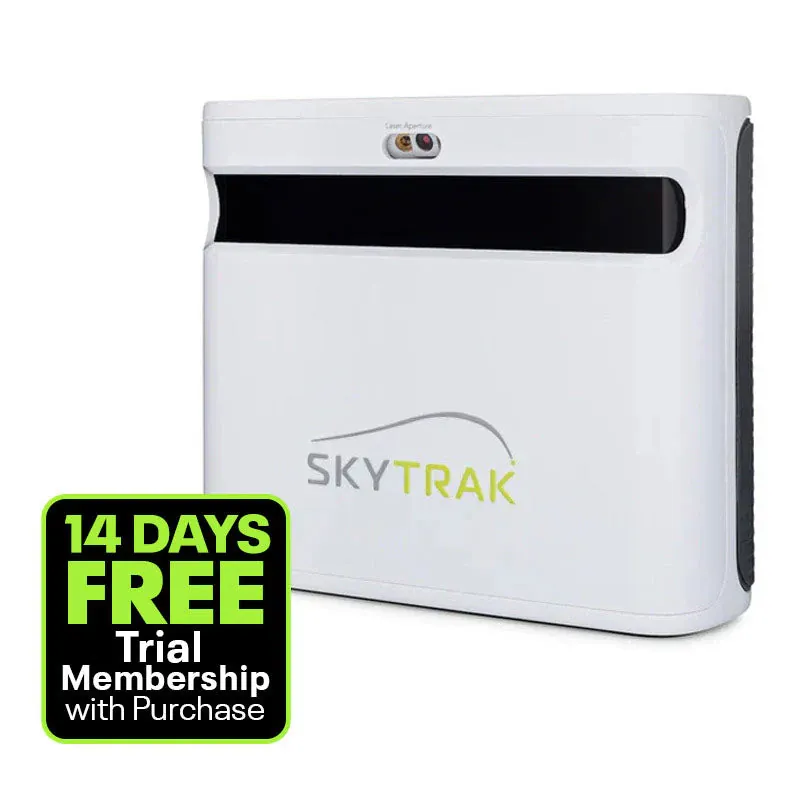
Left: SkyTrak+ for $2,195. Camera-based. Sits next to the ball. The Reddit favorite for indoor sim builds.
Right: Garmin Approach R10 for $499. Radar-based. Portable. Works indoors and outdoors. The budget gateway drug.
One costs almost four times as much as the other. And the expensive one isn’t obviously better — it’s better for a specific kind of golfer. Pick wrong and you’ll either overspend for features you’ll never use or underspend and end up frustrated with spin numbers that don’t match reality.
So we played 18 holes. Every criterion that matters — spin, accuracy, space, price, portability, putting, even boot speed and wife approval — gets a hole. The match went to the 18th.
Match Highlights
SkyTrak+ wins 1up. On the 18th hole. After the R10 ran the table on price and portability to nearly steal the whole thing.
Here’s how it went down. SkyTrak+ jumped out to a 3-up lead on the front nine — the accuracy holes. Spin, club data, putting. The camera measures; the radar estimates. That’s a real difference and it showed early.
Then the R10 started clawing back. It won the boot-speed hole (hole 5), the outdoor hole (7), the subscription hole (9). By the turn, the R10 had trimmed the lead to 2-up. Still SkyTrak+’s match to lose.
On the back nine, the R10’s charge came. Holes 12 and 13 — the price holes — were always going to the R10. $499 vs $2,195 isn’t a debate; it’s a statement. The R10 squared the match at 12, then took its first lead at 13. For the first time all day, the R10 was ahead.
The match seesawed. SkyTrak+ won hole 14 (build quality), R10 won 15 (travel bag). Hole 16 — wife approval — was halved, which set up the dramatic finish. All square standing on the 17th tee.
SkyTrak+ won 17 (data speed) to pull back level. Then came 18 — the finisher. One question: do you trust your data? SkyTrak+ measured everything. The R10 estimated half your numbers indoors. The camera wins that hole every time.
Final: SkyTrak+ 1up. The R10 made it a match. But 18 holes is a long day, and over 18 holes, measured beats estimated.
Who Should Buy What
Buy the SkyTrak+ if:
- You’re building a permanent indoor simulator in your garage or basement
- You care about spin accuracy for club fitting or improvement tracking
- You have 10+ feet of depth but not 18+
- You want putting in your sim rounds
- You’re done renting range time and want a real home setup
Buy the Garmin R10 if:
- Your budget ceiling is $600-$800
- You want to use it at the driving range too
- You have 18+ feet of depth indoors
- You’re testing the waters — not sure if you’ll stick with simulator golf
- Spin accuracy is “nice to have” not “need to have”
The honest truth: Most guys who buy the R10 and get hooked end up upgrading to a camera-based unit within 18 months. The R10 is the gateway drug — it gets you into sim golf, and then you want more. SkyTrak+ is the destination. If you already know you’re all in, skip the middleman and buy the SkyTrak+.
If you’re not sure yet, the R10 at $499 is one of the best value propositions in golf. You’ll get your money’s worth even if you upgrade later.
The Review
Spin Accuracy (Holes 1 & 10)
This is the decision. Everything else is detail.
SkyTrak+ is photometric. A high-speed camera sits beside the ball and captures images at the moment of contact. It reads ball speed, launch angle, spin rate, spin axis, and direction from those images — the same way a photographer captures a bullet through an apple. The data is measured. Not modeled. Not estimated. The camera saw it.
Garmin R10 is Doppler radar. It sits behind the ball and bounces radio waves off the ball as it flies through the air. With 100+ yards of ball flight outdoors, radar can track everything — full trajectory, spin, descent angle. With 8 feet of ball flight indoors, radar can measure ball speed, launch angle, and direction directly. But spin? It runs an algorithm. A best guess based on those five direct measurements.
Here’s the translation: the R10 is guessing at half your numbers indoors. The SkyTrak+ is watching them.
That’s not a knock on the R10. For $499, the fact that it works at all indoors is genuinely impressive. Garmin’s algorithm is better than it was two years ago. But if you’re trying to dial in your wedge spin, figure out why your 7-iron is carrying 155 instead of 160, or do a real club fitting — spin accuracy matters. And the R10 can’t give you that indoors.
The R10 is genuinely good at ball speed and launch angle. It gets those within spitting distance of units that cost four times as much. That’s not nothing — it’s a $499 device measuring ball speed at ±1 mph. Garmin’s hardware is excellent.
But spin is the weakness. Indoors — where you’ll be using it — the R10 has 8 feet of ball flight to work with. That’s not enough for radar to measure spin. So it runs an algorithm that models spin from launch angle, ball speed, and trajectory. It’s an educated guess. Sometimes it’s close. Sometimes it’s 1,500 rpm off. You won’t know which.
For casual practice? The R10 is fine. For someone who wants to actually track improvement and trust their numbers? SkyTrak+, and it’s not a conversation.
SkyTrak+ published accuracy:
- Ball speed: ±1 mph
- Launch angle: ±1 degree
- Spin rate: Measured directly (±150-200 rpm typical)
- Carry distance: ±2-3 yards
- No special balls needed. No dots. No stickers. Hit any ball.
Garmin R10 published accuracy:
- Ball speed: ±1 mph
- Clubhead speed: ±3 mph (loose)
- Launch angle: ±1 degree
- Launch direction: ±1 degree
- Carry distance: ±5 yards
- Spin: Estimated by machine learning
Putting (Hole 4)
The SkyTrak+ measures putting — speed, direction, distance. You can play full rounds where putting actually works.
The R10 doesn’t track putting at all. You’ll be tapping in with a gimme or using a secondary putting system. For full-round simulation, this matters more than you’d think. Read more on which launch monitors track putting.
Space Requirements (Hole 6)
This is where the R10 loses a lot of apartment and small-room buyers.
SkyTrak+:
- Sits beside the ball
- Needs ~1 foot of ball flight before the net
- Minimum total depth: ~10 feet
- Works in spare bedrooms, basements, tight garages
Garmin R10:
- Sits 6-8 ft behind the ball
- Needs 8+ ft of ball flight to the net
- Minimum total depth: 14 feet (tight)
- Recommended: 18+ feet
If your garage is 20 feet deep, both work fine. If you’re in a 12-foot spare bedroom, the R10 physically cannot fit. The SkyTrak+ will be happy as a clam.
This is the most common mistake I see: guys buying the R10 because it’s cheaper, then realizing their room isn’t deep enough for radar. Camera-based units sit next to the ball and need almost no depth. Radar sits behind you and needs ball flight. Measure your room before you buy anything.
Indoor vs Outdoor (Hole 7)
Here’s where the R10 has SkyTrak+ beat — and it’s not close.
The R10 is portable. 1.5 pounds. Fits in a golf bag. Battery lasts 10 hours. You can take it to the driving range, set it on the ground, and get full data with 100+ yards of ball flight. Outdoors, radar shines. The R10’s spin estimation actually gets decent when it can watch the ball fly for 50+ yards.
The SkyTrak+ is indoor only. It’s not designed for outdoor use. The camera needs controlled lighting. It’s a stationary unit that lives in your garage or basement. You don’t take it to the range.
If you want one device that does both — indoor practice in the winter, outdoor range sessions in the summer — the R10 is the only choice here. SkyTrak+ is a dedicated indoor tool.
Software & Simulation (Hole 9)
Both connect to the major simulator platforms.
SkyTrak+ software options:
- GSPro ($250 one-time, via community connector) — the community favorite. 150+ courses. Beautiful graphics. No subscription.
- E6 Connect ($300/year subscription or $2,500 lifetime) — 27 courses included. Good online play.
- TGC 2019 ($950 one-time) — 150,000+ community-designed courses. Insane variety.
- WGT Golf (free with SkyTrak+ subscription) — mobile-friendly.
SkyTrak+ requires a $199/year subscription for simulator software access (or $2,995 lifetime). Without the subscription, you get the driving range and basic data only. That’s a real cost — the subscription math adds up.
Garmin R10 software options:
- Garmin Golf app (free) — driving range, data, session history. No subscription required for this.
- E6 Connect ($300/year) — included with R10 purchase for 1 year. After that, subscription.
- GSPro ($250 one-time) — works with R10 via community connector. Not official but works.
- Home Tee Hero (included) — 43,000+ courses. Basic graphics but functional.
The R10 gives you more out of the box without subscriptions. The SkyTrak+ locks simulator play behind a paywall. That $1,400 price gap narrows when you factor in three years of SkyTrak’s subscription ($597).
Battery Life
The R10 gets up to 10 hours on a charge. The SkyTrak+ runs on AC power — no battery. You plug it in.
If you’re doing long sessions or want to take it somewhere without an outlet, the R10 wins. If you’re building a permanent sim bay with power nearby, this is a non-issue.
Price (Holes 12 & 13)
| SkyTrak+ | Garmin R10 | |
|---|---|---|
| Hardware | $2,195 | $499 |
| 3-year software cost | $597 (subscription) or $2,995 lifetime | $0 (Garmin Golf free) or $300/yr E6 |
| 3-year total | $2,792 (subscription) or $5,190 (lifetime) | $499 (free app) or $1,499 (with E6) |
The R10 is dramatically cheaper. Even with E6 subscription for three years, you’re at $1,499 — less than the SkyTrak+ hardware alone. That’s real money. That’s the difference between “I’m buying a launch monitor” and “I’m building a full simulator setup.”
For a deeper breakdown of all-in costs, the cost guide breaks it down by tier.
The Full Round
Every hole, every winner, the complete play-by-play. This is the match that decided it.
Hole 1 — Spin Truth
SkyTrak+ wins. Camera reads spin directly from the ball’s dimples — no dots, no stickers, no guessing. R10 estimates spin via machine-learning algorithm with 8 feet of ball flight. The camera is watching; the radar is guessing. SkyTrak+ 1 up.
Hole 2 — The Numbers Game
Halved. Both units measure ball speed within ±1 mph and launch angle within ±1 degree. On the direct measurements — ball speed, launch angle, direction — these two are dead even. The R10’s hardware is genuinely excellent for $499. SkyTrak+ still 1 up.
Hole 3 — Club Data
SkyTrak+ wins. Full club data: clubhead speed, angle of attack, face angle, club path. The R10 gives you clubhead speed at ±3 mph — and that’s it. It’s a loose estimate, not a measurement. If you’re doing club fitting, this hole matters. SkyTrak+ 2 up.
Hole 4 — The Green
SkyTrak+ wins. Putting. Speed, direction, distance. SkyTrak+ measures it. R10 doesn’t track putting at all — you’re tapping in with a gimme or using a secondary system. For full-round simulation, this is bigger than people think. SkyTrak+ 3 up.
Hole 5 — Quick Draw
R10 wins. 🚀 From button press to first swing: the R10 boots, connects to your phone via Bluetooth, and you’re hitting balls in under a minute. The SkyTrak+ needs to boot, pair to your network, load the app, and connect to the Wi-Fi network. It’s not slow — but it’s not fast either. SkyTrak+ 2 up.
Hole 6 — The Long Game
SkyTrak+ wins. Space requirements. The SkyTrak+ sits beside the ball and needs ~10 feet of total depth. The R10 sits 6-8 feet behind the ball and needs 14 feet tight, 18+ recommended. If you’re in a spare bedroom or a tight garage, the R10 physically cannot fit. This is the hidden dealbreaker for a lot of buyers. SkyTrak+ 3 up.
Hole 7 — Out of Bounds
R10 wins. Outdoor use and portability. The R10 is 1.5 pounds, battery-powered for 10 hours, and works at the driving range with 100+ yards of ball flight. Outdoors, radar shines and the spin estimation actually gets decent. The SkyTrak+ is indoor-only. Not close. SkyTrak+ 2 up.
Hole 8 — Cable Chaos
Halved. 🔌 The R10 is wireless — but it needs a phone mount, a stand, and a clear line of sight behind the ball. The SkyTrak+ has one power cable and a network connection — but once it’s set up, it’s clean and permanent. Both have cable sins. Call it even. SkyTrak+ still 2 up.
Hole 9 — The Subscription Tax
R10 wins. The Garmin Golf app is free — driving range, data, session history, no subscription. SkyTrak+ locks simulator play behind a $199/year subscription ($2,995 lifetime). Over three years, that’s $597 in subscription fees on top of the hardware. The R10 gives you more out of the box. SkyTrak+ 1 up.
Hole 10 — Spin Truth II
SkyTrak+ wins. Spin consistency over time. The camera measures spin the same way every time — it’s a physical measurement. The R10’s algorithm can drift. Wedge spin control, 7-iron spin consistency, tracking improvement over months — the measured spin holds up. The estimated spin is a moving target. SkyTrak+ 2 up.
Hole 11 — The 2 AM Factor
R10 wins. 🌙 It’s 2 AM. You can’t sleep. You want to hit balls. The R10: pick it up, set it on the ground, pair to your phone, hit balls. Battery-powered, quiet, no wires. The SkyTrak+: plug in the power, connect to the network, load the app, hope the Wi-Fi cooperates. At 2 AM, the R10 is the one you grab. SkyTrak+ 1 up.
Hole 12 — The Price Tag
R10 wins. $499 vs $2,195. This isn’t a debate. Four times the price. The R10 is one of the best value propositions in all of golf technology. This is the R10’s home hole and they run the table here. All square.
Hole 13 — The Real Cost
R10 wins. Three-year total cost of ownership. R10: $499 (free app) or $1,499 (with E6 for three years). SkyTrak+: $2,792 (subscription) or $5,190 (lifetime). Even with the R10’s E6 subscription, you’re at less than the SkyTrak+ hardware alone. The real cost gap is enormous. Garmin R10 1 up. First time the R10 has led all day.
Hole 14 — Built Different
SkyTrak+ wins. Build quality. The SkyTrak+ is a purpose-built stationary unit — solid, designed to live in one place and do its job for years. The R10 is plastic-compact, designed to be thrown in a golf bag. That portability comes with a build tradeoff. All square.
Hole 15 — Travel Bag
R10 wins. ✈️ 1.5 pounds. Fits in a golf bag. Battery-powered. You can fly with it, take it on vacation, use it at a friend’s house. The SkyTrak+ is a stationary unit that lives in your garage. You’re not traveling with it. Garmin R10 1 up.
Hole 16 — Wife Approval
Halved. 💍 The R10 is small and can be put away when not in use — but when it’s out, it looks like a radar detector on a stick. The SkyTrak+ is larger and takes up permanent space — but it looks like a designed product, not a gadget. Both have aesthetic sins. The R10 sins by looking cheap; the SkyTrak+ sins by taking up space. Halved. Garmin R10 still 1 up.
Hole 17 — Data Speed
SkyTrak+ wins. Latency. The camera processes at the moment of impact — data is on screen almost instantly. The R10’s radar has a brief processing delay as the algorithm calculates the estimated values. It’s not long, but it’s there. When you’re in a groove, you want your numbers now. All square. Stepping to 18.
Hole 18 — The Finisher
SkyTrak+ wins. Overall data confidence. The one question that matters when everything else is close: do you trust your numbers? The SkyTrak+ measured everything. The R10 estimated half of them indoors. When you’re dialed in on your swing, when you’re tracking your progress over months, when you’re making buying decisions based on your data — you need to trust it. The camera earns that trust. The algorithm asks for it.
SkyTrak+ wins 1up. Match decided on the 18th hole.