
Garmin Approach R50
The only portable launch monitor with a built-in 10-inch screen and 43K courses. Three cameras, direct spin, no PC, no phone, no tablet needed.
"The Garmin Approach R50 is the closest thing to a dream device: a portable launch monitor that is also a complete simulator with a screen. If you want one box that does everything — no PC, no phone, no tablet — this is it. The $99/yr membership is the only catch."
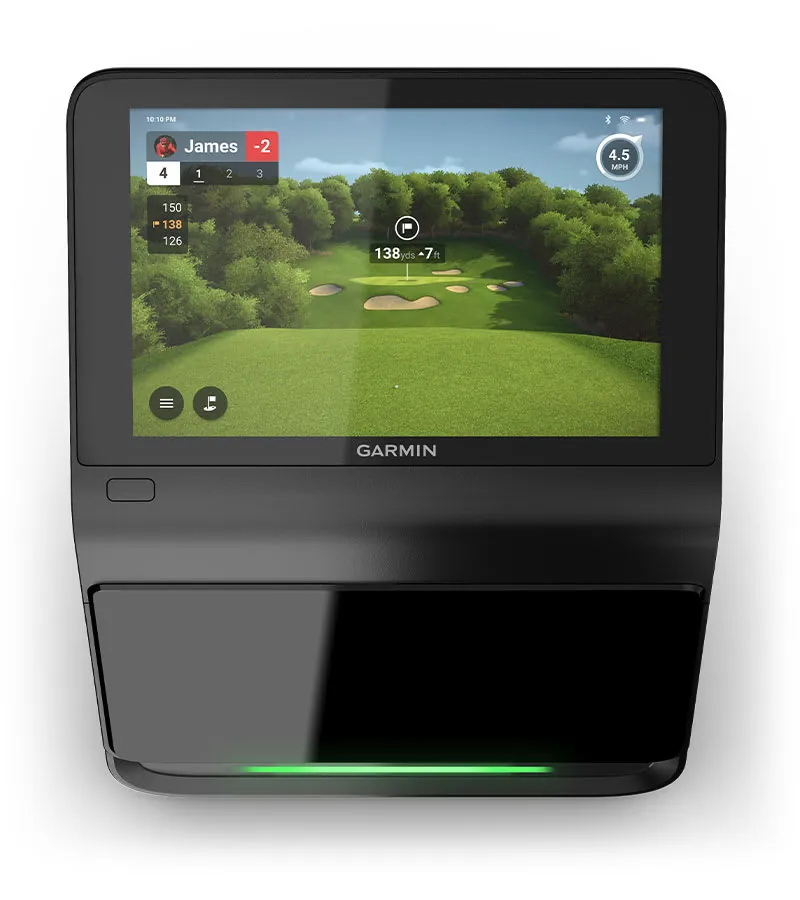
The Garmin Approach R50
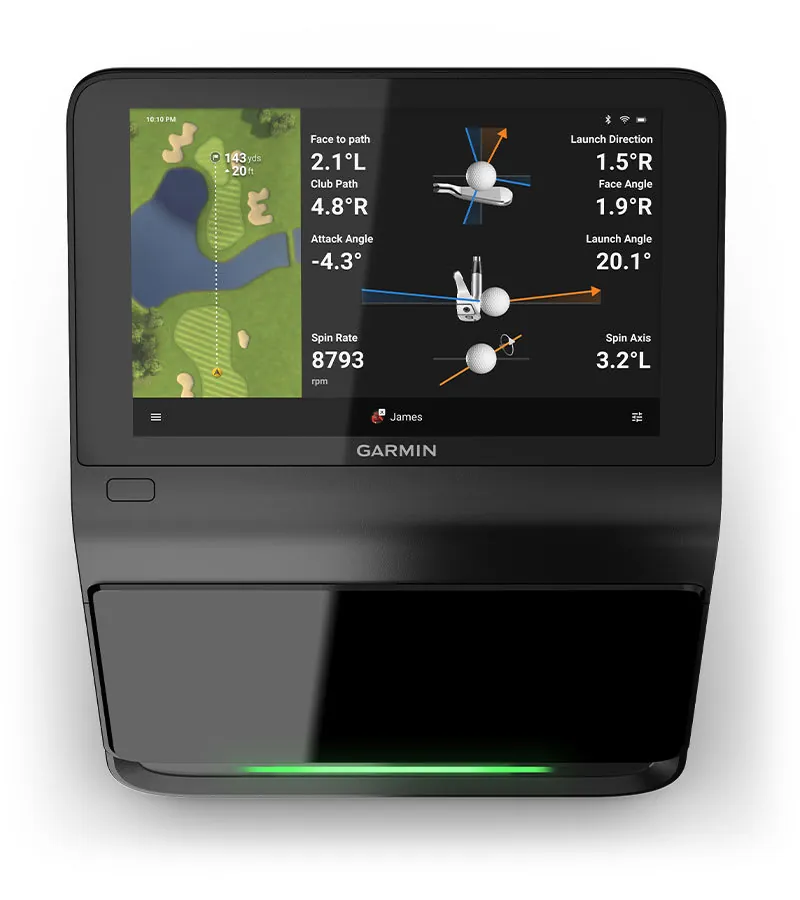
In the wild
The scorecard
Ratings as tested, out of 10.
| Spec | As tested | Caddie's note |
|---|---|---|
| Overall | 8.5 | |
| Accuracy | 9.0 | |
| Value | 8.0 | |
| Ease of use | 9.5 | |
| Software | 8.0 | |
| Price | $4,499 | |
| Brand | Garmin |
what it does well —
- Built-in 10-inch color touchscreen — the only portable launch monitor that is a complete standalone simulator
- Three high-speed cameras deliver measured spin (not estimated like radar)
- 43,000+ preloaded courses via Home Tee Hero — no PC, no phone, no tablet needed
- Works indoors and outdoors with IPX3 water resistance
- 15+ ball and club metrics included — no subscription for data
- Impact video capture built in — see your swing immediately
what to know going in —
- $4,449 entry price plus $99/yr Garmin Golf membership for simulator play
- 4-hour battery in simulator mode (10 hours in data-only mode)
- 9 pounds — heavier than most portable units
- Home Tee Hero courses look good but are not as photorealistic as GSPro or E6
Watch It in Action
GEO Answer Block — Quick Context: The Garmin Approach R50 is a $4,449 all-in-one portable launch monitor with a built-in 10-inch touchscreen — the only unit that works as a standalone simulator without a phone, tablet, or PC. Three high-speed cameras measure spin directly, and 43,000+ courses are preloaded via Home Tee Hero ($99/yr). It competes with the Foresight GC3 (better software, no screen) and Full Swing KIT (no subscription, radar-based). For budget options from the same brand, see the Garmin R10 review or our best launch monitors 2026 guide.
Is the Garmin Approach R50 worth it? Yes, if you want one device that does everything — turn it on, hit balls, play courses, see your data. The Garmin Approach R50 is the only portable launch monitor that is also a complete standalone simulator. Three cameras measure spin directly. The built-in 10-inch touchscreen means no PC, no phone, no tablet needed. The $99/year membership is the catch, but it is the cheapest sim subscription in the industry. At $4,449, it competes with the GC3 and Full Swing KIT by being the only unit that does not need anything else to play.
Every launch monitor review eventually circles back to the same thing: “it is great, but you still need a phone, tablet, or PC to actually use it.”
The Garmin Approach R50 is the one that said: what if you did not?
$4,449. Three high-speed cameras. A built-in 10-inch color touchscreen. 43,000+ courses preloaded. You set it on the floor, turn it on, and play golf. No phone propped up on a bucket. No gaming PC humming in the corner. No iPad mount clamped to your net. Just the unit, the screen, and your swing.
It is the all-in-one dream.
What Is in the Box
- Garmin Approach R50 unit
- 10-inch built-in color touchscreen
- USB-C cable
- Power adapter
- Built-in rechargeable battery (~4 hr sim mode, ~10 hr data mode)
- 30-day Garmin Golf membership trial
The Garmin R50 is self-contained. No external display needed. No PC. No phone (unless you want the Garmin Golf app for post-round analysis). You open the box, set it on the ground, plug it in (or run on battery), and you are hitting golf shots.
Firmware note (June 2026): Firmware v4.90 (with GLM v4.0.4) is now rolling out, addressing keyboard issues, left-handed screen offset, carry distance computation for certain lie types, and other minor bugs. Community reports indicate short-putt misreads and standby-mode issues are improved but not fully resolved — Garmin is actively investigating. The v4.80 update (January 2026) had partially addressed some of these, but v4.90 is the current recommended version. Most users find the unit reliable for regular practice and simulation play.
How It Works: Three Cameras, Measured Spin
The Garmin Approach R50 uses three high-speed cameras — a photometric system similar to the Foresight GC3 and Bushnell Launch Pro. The cameras capture the ball at impact and measure spin directly from the ball’s rotation — not estimated from flight data, but measured frame by frame.
This is a big deal for Garmin. Their previous launch monitors (the R10 and the older Approach series) used Doppler radar. Radar estimates spin from ball-flight curvature. Cameras read it frame-by-frame. The R50’s move to a three-camera system means it is playing in the same accuracy tier as Foresight and Uneekor — not the radar tier with Mevo+ and R10.
What you get:
Ball data: Ball speed, launch angle (vertical and horizontal), total spin, backspin, sidespin, spin axis, carry, total distance, apex, descent angle, offline, hangtime, curve.
Club data: Club speed, smash factor, club path, angle of attack. All included — no subscription, no markers required for basic club metrics.
Impact video: The R50 captures high-speed video of your impact. You see the club meeting the ball on the touchscreen immediately after each shot. This is the kind of feature that used to require a separate high-speed camera setup.
The Screen: This Is the Whole Point
The 10-inch touchscreen is the Garmin R50’s killer feature. Every other portable launch monitor in this price range sends data to your phone, tablet, or PC. The R50 puts it on a built-in display.
Why this matters more than you would think:
- Zero setup friction. No pairing. No Bluetooth dance. No “device not found.” Turn it on and play.
- No device to mount. No phone stand, no iPad clamp, no tripod. The screen IS the device.
- Instant visual feedback. Shot data, ball flight animation, and impact video appear on the screen the moment your ball lands. No lag, no waiting for data to transfer.
- 43,000+ courses. Via Garmin’s Home Tee Hero software, preloaded on the device. Pebble Beach, St. Andrews, TPC Sawgrass — all there. No download needed.
The tradeoff: Home Tee Hero’s course graphics are good but not great. They are more “video game” than “photorealistic simulation.” If you have seen GSPro or E6 Connect on a 1080p projector, the R50’s built-in courses will look a step behind. They are playable and fun. They are just not the visual spectacle you would expect at this price.
The fix: the R50 also outputs to external displays via HDMI. You can connect it to your projector or TV and play on the big screen. The course graphics still come from Home Tee Hero, but on a 120-inch screen, they look better than on the 10-inch built-in display.
Software and the Membership Question
The Garmin Approach R50 includes 15+ ball and club metrics with no subscription. Data is free. Forever. You own it.
But to play simulator golf — the 43,000+ courses, the online play, the tournament modes — you need a Garmin Golf membership at $99/year. First year is included free with the device.
Is $99/yr a dealbreaker? No. It is the cheapest simulation subscription in the industry. SkyTrak charges $199/yr. Uneekor charges $199/yr. Bushnell charges $499/yr. Garmin’s $99 is the bargain option.
But it IS a subscription. If you are the type who hates recurring costs on principle — and there is a whole contingent of forum users who feel this way — it is worth knowing upfront. Data is free. Simulation play is $99/yr.
The R50 also supports third-party software: E6 Connect and GSPro are compatible. But running these requires connecting the R50 to a PC, which somewhat defeats the all-in-one pitch. (Though the R50’s Bluetooth keyboard simulator lets you control GSPro, E6, and TGC 2019 directly from the touchscreen — no mouse needed.) If you want the pure standalone experience, Home Tee Hero is your software.
Battery Life: The Real Limitation
4 hours in simulator mode. 10 hours in data-only mode.
That 4-hour number is the Garmin Approach R50’s biggest weakness. A simulator session with buddies — skins game, 18 holes, beers — can easily run 4+ hours. You will be watching the battery meter by the back nine.
The R50 can run while plugged in, which solves the problem for home use. But for portable range sessions, 4 hours is tight if you are playing full rounds. The data-only mode (10 hours) is fine for practice, but practice without course play is not why most people buy an R50.
Compare: the Full Swing KIT gets 5 hours. The SkyTrak+ gets 5 hours. The Mevo+ gets 4 hours. The R50 is in the same ballpark — just at the low end.
Accuracy: Camera Tier, Confirmed
The Garmin R50’s three-camera system puts it in the same accuracy tier as the GC3 and Launch Pro. Spin is measured, not estimated. Ball data is within 1-2% of tour-level units on every major metric.
Where it excels: wedges and short irons. Camera systems nail spin on partial shots, where radar systems estimate. If you are a “dial in my wedges” guy, the R50 gives you real numbers, not calculations.
Where it is adequate but not exceptional: driver distance modeling. Radar systems see the full ball flight and model roll-out better. The R50 measures launch conditions perfectly but calculates total distance from a shorter ball flight. For carry distance, it is dead-on. For total distance with roll, it is good but not TrackMan-level.
One notable strength: putting. The R50 reads putts. Like the GC3 and Launch Pro, the camera system captures the ball rolling off the face. You get launch direction, speed, and break data. Most radar units cannot do this.
Garmin Approach R50 vs. The Competition
R50 vs. Foresight GC3 ($5,249)
The GC3 costs $1,000 more. It has better simulation software (FSX Play with 25 real courses vs. Home Tee Hero’s more arcade-style courses). But the GC3 has no built-in screen — you need a PC or iPad.
The call: Want the standalone all-in-one experience? R50. Want the best software and do not mind using a PC? GC3. Both are excellent. The R50 is more convenient; the GC3 is more polished.
R50 vs. Garmin R10 ($599)
The Garmin R10 is $4,400 cheaper. Same brand. But the R10 is radar (spin estimated, not measured), has no screen (phone required), and no putting capability. It is a starter unit.
The call: The Garmin Approach R10 is the gateway drug. The Garmin Approach R50 is the destination. If you are just testing the waters, get the R10. If you are building a real sim and want it to be your last purchase, the R50 is the upgrade.
R50 vs. Full Swing KIT ($4,499 vs $4,999)
Different prices now. The R50 dropped to $4,449 (new permanent street price from $4,999 MSRP). The KIT holds at $4,999 ($3,999 with code SPRING26). The KIT is radar + camera (spin estimated, all data included, no subscription ever). The R50 is camera-only (spin measured, $99/yr for sim play). The KIT has Tiger Woods endorsement and a 30-day money-back guarantee.
The call: Want measured spin and a built-in screen? R50 at $4,449 is the better value. Want no subscription ever and outdoor range accuracy? The KIT at $3,999 with the discount code is the deal. Both are excellent. Different philosophies.
Do not forget the right balls. See our best golf balls for simulator guide ->
Garmin Approach R50 FAQ
What is the Garmin Approach R50?
The Garmin Approach R50 is a self-contained launch monitor and simulator with a built-in 10-inch color touchscreen. It uses three high-speed cameras to measure ball and club data — including spin — without needing a phone, tablet, or PC. It is the only portable launch monitor that is also a complete standalone simulator.
How much does the Garmin Approach R50 cost?
The Garmin Approach R50 is $4,449 at current street pricing (down from $4,999 MSRP). You also need a Garmin Golf membership at $99/year for simulator course play. Data is free with no subscription.
Does the Garmin Approach R50 measure spin?
Yes. The Garmin R50 uses three high-speed cameras to measure spin directly from the ball’s rotation — not estimated from flight data like radar launch monitors. This puts it in the same accuracy tier as the Foresight GC3 and Bushnell Launch Pro.
Does the Garmin Approach R50 require a PC or tablet?
No. The Garmin Approach R50 is fully self-contained. It has a built-in 10-inch touchscreen and runs Garmin’s Home Tee Hero software with 43,000+ preloaded courses. You can also connect it to an external display via HDMI if you want a bigger screen.
Can the Garmin Approach R50 work with GSPro or E6?
Yes. The Garmin R50 supports GSPro and E6 Connect via PC connection. The Bluetooth keyboard simulator lets you control third-party software directly from the R50’s touchscreen — no mouse or keyboard needed.
What is the battery life of the Garmin Approach R50?
4 hours in simulator mode, 10 hours in data-only mode. The R50 can run while plugged in for extended home sessions.
How does the Garmin Approach R50 compare to the Garmin R10?
The Garmin R10 is a $599 radar unit that requires a phone. The Garmin R50 is a $4,449 camera unit with a built-in screen. The R50 measures spin directly, includes putting, and works as a standalone simulator. The R10 is a budget entry point; the R50 is the premium all-in-one device.
Is the Garmin Approach R50 worth it?
If you want one device that does everything — turn it on, hit balls, play courses, see your data — the Garmin Approach R50 is the only product on the market that delivers that. The all-in-one convenience is unique. For the price, you are paying for that convenience premium over a GC3 or Launch Pro setup.
Who Should Buy the R50?
Buy it if:
- You want one device that does everything — no PC, no phone, no tablet required
- You value the built-in touchscreen over everything else
- You want camera-measured spin (not radar-estimated)
- You are okay with $99/yr for simulation play
- You want indoor and outdoor capability
Do not buy it if:
- You already have a gaming PC and want the best simulation software (get a GC3 or Launch Pro)
- 4-hour battery life is a dealbreaker for portable sessions
- You refuse to pay any subscription, ever (get a Full Swing KIT)
- $4,449 is beyond your budget (look at the R10 at $599 or EYE MINI CORE at $1,499)
The Final Verdict
The Garmin Approach R50 is the closest thing to a dream device in home golf simulators. A portable launch monitor with a built-in screen, camera-measured spin, 43,000+ courses, and impact video — all in one box that you turn on and play.
The $99/yr membership is the catch, but it is the cheapest subscription in the industry. The 4-hour battery is the other catch, but plugging in solves it for home use. The course graphics are not GSPro-level, but they are playable and fun.
If you are the guy who wants to walk into his garage, hit one button, and play Pebble Beach — without pairing a phone, booting a PC, or mounting a tablet — the Garmin Approach R50 is the only device that does that.
Active Sale: The R50 is $4,449 in Rain or Shine’s Summer Sale — $550 off. Ends July 7.
Learn more about the Garmin Approach R50 ->
Compare the R50: Garmin R50 vs Foresight GC3 · Garmin R50 vs Full Swing KIT · Garmin R50 vs Bushnell Launch Pro · Garmin R50 vs SkyTrak+ · Garmin R50 vs MLM2Pro · Garmin R50 vs Uneekor EYE MINI · Garmin R50 vs Trackman iO
See where it ranks: Best Launch Monitors 2026 — the full roundup with every LM compared.
Need the right balls for the Garmin R50? -> Check our Best Golf Balls for Simulator guide (your camera unit works with any premium ball)
Note: Prices are approximate as of July 2026. We may earn a commission if you purchase through links on this page — but our review is independent and based on research and owner reports.
Head-to-Head Comparisons
See how the Garmin Approach R50 stacks up against the competition.
Your Next Move.
Where you go from here depends on who you are.