
You’ve got five thousand dollars burning a hole in your pocket. And you’ve narrowed it down to two launch monitors that somehow cost the exact same amount.
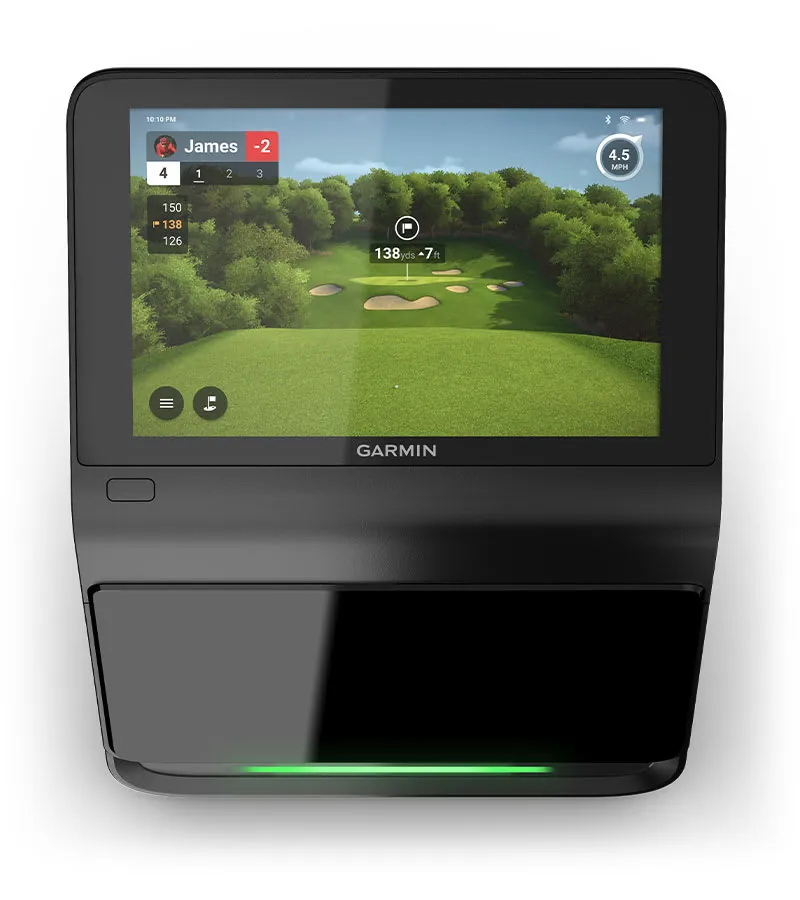
The Garmin Approach R50 — a camera-based all-in-one that runs simulation software on its own built-in 10-inch screen. (I’ve got a full R50 review here.)
The Full Swing KIT — Tiger Woods’ personal launch monitor, a radar unit with a 4K camera and an OLED display that fits in your golf bag. (Read my Full Swing KIT review for the full breakdown.)
Same price. Completely different philosophies. And picking the wrong one means you’ll be annoyed at yourself every time you use it.
The Quick Version
| Garmin Approach R50 | Full Swing KIT | |
|---|---|---|
| Price | $4,999.99 | $4,999.00 |
| Technology | 3 high-speed cameras (photometric) | 24GHz dual-mode radar + 1080p camera |
| Placement | Beside the ball | 8–10 ft behind the ball |
| Built-in screen | 10“ color touchscreen | 5.3“ OLED (1920x1080) |
| Onboard sim | Yes Yes — runs Home Tee Hero natively | No No — requires tablet or PC |
| Data metrics | 15+ ball & club | 16 ball & club |
| Weight | 9 lbs | 4 lbs |
| Battery | 4 hours | 5 hours |
| GSPro compatible | Yes Yes | Yes Yes |
| Best for | Indoor simulator, tight spaces, all-in-one | Outdoor range, mixed righty/lefty, data nerds |
R50 wins for anyone building a dedicated indoor simulator. Full Swing KIT wins if you want range portability and Tiger Woods’ endorsement. (See how the KIT stacks up against the Bushnell Launch Pro for another comparison at this price.) Neither is wrong. But one is wrong for you if you pick without understanding the room you’re putting it in.
The Whole Thing in One Paragraph
The R50 sits next to the ball, has a 10-inch touchscreen that runs simulator software without any other device, and needs almost zero depth — just enough room to swing a club. You set it on the ground, turn it on, and start playing Pebble Beach on the built-in screen or connected to a projector via HDMI.
The Full Swing KIT sits 8 to 10 feet behind the ball, has a small OLED display for quick data, and needs an iPad, PC, or phone to run simulator software. It’s built around radar — the same technology TrackMan uses — combined with a 1080p camera that captures your entire swing in color video.
One is “turn on and play.” The other is “set up a system.”
One is a complete simulator in a box. The other is a launch monitor that can become a simulator. (Our all-in-one vs component sim build guide covers the trade-offs.)
That’s not a value judgment. It’s a practical difference that determines which one works in your space.
Technology: Camera vs Radar
This is where everything starts.
Garmin R50 uses three high-speed cameras — the same triscopic approach as the Foresight GC3. Three cameras sit inside the unit, positioned beside the ball, and capture the impact from multiple angles. They fire a sequence of images at the moment of contact — same way a photographer captures a bullet through an apple — and calculate ball speed, launch angle, spin rate, and club data from those frames.
This means the R50:
- Sits beside the ball (not behind you)
- Needs almost no depth — just swing room
- Works in tight spaces — garages, basements, spare bedrooms
- Tracks spin from the first few inches of flight
Full Swing KIT uses 24GHz dual-mode radar enhanced with machine learning. It sits behind the ball and bounces radio waves off the ball as it flies through the air — same physics as a police radar gun, but way more sophisticated. A 1080p camera running at 60fps captures swing video on top of the radar data.
This means the KIT:
- Sits 8–10 ft behind the ball
- Needs 16+ ft total depth minimum
- Works best with longer ball flight — more data for the radar to process
- Is uncompromising outdoors where radar loves open air
Radar is better outdoors, cameras are better indoors. That’s not a preference. That’s physics. Radar needs ball flight to measure spin. Cameras measure everything at impact. If you’re building a garage setup where you’ll have 8 feet of ball flight, the camera wins. If you’re taking this to the range every weekend, the radar has the edge.
The R50 is the indoor specialist. The KIT is the dual-threat that’s elite outdoors and good indoors.
Indoor Performance: Where the R50 Pulls Ahead
This is the R50’s home court.
Because it sits beside the ball and measures everything at impact, it doesn’t care how much room is behind you. You could set it up in a closet-sized room (assuming you can swing a club in there) and it would read your data correctly.
The R50’s 10-inch touchscreen means you don’t need anything else. You don’t need a phone. You don’t need a tablet. You don’t need a gaming PC. You turn it on, select Home Tee Hero, and you’re playing a course with 43,000 options in under a minute. The screen is bright, responsive, and big enough to actually play on — though if you want the full experience, you can HDMI out to a projector.
No other launch monitor at this price does this. The R50 is a complete simulator in one box. Screen. Computer. Software. Launch monitor. All of it.
The Full Swing KIT indoors is… fine. It works. It’s accurate — radar does measure spin, it just needs ball flight to do it. With Titleist RCT balls or metallic dots, the KIT gets reliable spin data indoors. But it needs that 8-10 feet behind you. If your garage is a standard 20-foot two-car, you’re fine. If you’re trying to squeeze this into a 14-foot spare bedroom, you physically cannot make it work.
One more thing: the R50 is a nightmare for mixed righty/lefty use. Because it sits beside the ball, you have to physically move it to the other side. The KIT sits behind the ball — it doesn’t care if you’re righty or lefty. If you share your sim with a left-handed buddy, the KIT is the obvious choice.
Outdoor Performance: Where the KIT Shines
This is the Full Swing KIT’s element.
Radar outdoors is a different beast. With 100+ yards of ball flight, the KIT’s 24GHz radar can track the ball’s entire trajectory — spin rate, spin axis, launch angle, everything — with tour-level accuracy. The 1080p camera captures your full swing in color video, which you can review shot by shot in the Free KIT app.
The KIT was literally tested by Tiger Woods. That’s not just marketing — Tiger uses this as his personal launch monitor. He’s not a guy who tolerates inaccurate data.
The R50 works outdoors too. The cameras don’t care about sunlight as long as it’s not direct glare. You can set it up on the range and get accurate data. But it’s a 9-pound unit with a 4-hour battery. It’s portable in the sense that you can carry it to the range. The KIT is 4 pounds with a 5-hour battery and a smaller form factor that actually fits in a golf bag carry case.
Outdoors, the KIT is the better tool. Indoors, the R50 is the better tool. If you do both equally, you’ve got a real decision to make.
Screens and Interfaces
This is a bigger deal than you think.
The R50 has a 10-inch color touchscreen that’s essentially an iPad built into a launch monitor. It’s big. It’s bright. It runs the entire Garmin Home Tee Hero interface — course selection, shot data, practice modes — all on-device. You don’t need to connect anything to use it. You can play a full round on the built-in screen if you want. It’s not as immersive as a projector, but it works.
The Full Swing KIT has a 5.3-inch OLED display with 1920x1080 resolution and 16.7 million colors. It’s gorgeous — OLED blacks are true blacks, the colors pop, and it’s incredibly readable in direct sunlight. But it’s small. You can customize it to show 1-4 data metrics at a time. You scroll through data between shots. It’s not a simulator screen — it’s a data display.
The KIT’s real interface is the app. And that’s a complication: the KIT app is iOS-only. No Android. If you’re an Android user, you’re connecting to a PC or using the tiny OLED display. That’s a real limitation that the R50 doesn’t have — the R50’s screen is the interface.
Data and Accuracy
Both give you full ball and club data with no subscriptions required for basic use.
Garmin R50 measured data: Ball speed, launch angle, launch direction, spin rate, spin axis, apex height, carry distance, total distance, clubhead speed, club face angle, angle of attack, smash factor, path angle. Plus automatic slow-motion impact video (black and white, but you can see the club strike the ball).
Full Swing KIT measured data: Ball speed, launch angle, horizontal angle, spin rate, spin axis, smash factor, carry distance, total distance, side carry, side total, apex height, clubhead speed, club path, face angle, face to path, angle of attack. Plus 1080p color swing video at 60fps.
The KIT gives you face to path and side carry/side total that the R50 doesn’t show as standard. The R50 gives you a bigger screen and onboard simulation.
Both are genuinely accurate at this price point. We’re talking 1–2% variance from units that cost three times as much. The question isn’t which is more accurate — it’s which data do you need and where are you using it.
Simulator Software
This is where the two paths diverge hard.
Garmin R50 runs Home Tee Hero natively on the device — no PC, no tablet, nothing else needed. 43,000+ courses. Practice ranges. Target games. It’s all on the 10-inch screen or you can HDMI to a projector for the full sim experience. Home Tee Hero requires a Garmin Golf membership at $9.99/month or $99/year. That’s your subscription cost.
The R50 also connects to GSPro (runs from a PC), E6 Connect, E6 Apex, and Awesome Golf. The connection is wireless via the R50’s hotspot. It’s plug-and-play — select GSPro on the R50’s screen, connect your PC to the R50’s WiFi, and you’re in.
Full Swing KIT does not run simulator software on-device. You need a tablet, phone, or PC. The KIT includes an E6 Connect Perpetual Package with 5 courses and 15 practice areas — free, no subscription. That’s decent. You also get the Full Swing App for data tracking and swing video.
The KIT also works with GSPro and supports Full Swing Golf on KIT — a premium software package at $500/year that unlocks 15 iconic courses including TPC Sawgrass and Spyglass Hill.
If you want to play simulator golf without a PC, the R50 is your only choice at this price. The KIT requires a device.
Price and Total Cost
Both launch monitors are $4,999. Identical price point. That’s the headline.
But the total cost differs depending on what you’re doing:
| Garmin R50 | Full Swing KIT | |
|---|---|---|
| Launch monitor | $4,999.99 | $4,999.00 |
| Sim software (annual) | $99/yr (Home Tee Hero) | $0 (E6 5-course perpetual) |
| Premium sim (annual) | $250/yr (GSPro) | $500/yr (Full Swing Golf) |
| Needed for sim play | Nothing — runs on device | iPad, PC, or phone |
| App subscription (optional) | Included in $99/yr | $99/yr (cloud storage, video) |
The R50 is cheaper to run for casual sim play — $99/year gets you 43,000 courses on-device. The KIT gets you started with 5 free courses and no subscription, but if you want the full course library you’re paying $500/year or buying GSPro at $250/year plus needing a computer.
Portability
Full Swing KIT: 4 pounds. Compact case. Fits in a golf bag. 5-hour battery. This is the portable option. You can take it to the range, set it up in 90 seconds, get 16 data points with swing video, and pack it up. It’s designed for the guy who plays real golf and wants data on the range.
Garmin R50: 9 pounds. Comes with a large carrying case (reviewers compare it to a Yeti cooler). 4-hour battery. You can bring it to the range, but it’s not a grab-and-go experience. The R50’s portability is more about “move it from the garage to the living room” than “toss it in the trunk.”
If you want a range tool, buy the KIT. If you want a garage tool, buy the R50.
The Tiger Factor
I’m not going to pretend this doesn’t matter.
Tiger Woods uses the Full Swing KIT. He’s said, quote: “I know that Full Swing is measuring my golf ball, not guessing at it.” That’s a real endorsement from the most demanding golfer who has ever lived.
Does that mean the KIT is better? No. Tiger uses what he’s paid to use, and what works in his setup. But the endorsement means the KIT has been tested at a level almost no other launch monitor has. If it’s good enough for Tiger on his home practice tee, it’s good enough for you.
The R50 doesn’t have a Tiger Woods endorsement. It has something almost as valuable: the independent verdict that it’s the most innovative launch monitor of 2025. The built-in simulator is genuinely new. No one else does this.
The Verdict
Buy the Garmin Approach R50 if:
- You’re building a dedicated indoor simulator and that’s where it stays
- Your space is tight — spare bedroom, small garage bay, basement nook
- You want to play sim golf without a PC — just the unit and a projector
- The built-in 10-inch screen sounds like a feature you’d actually use (it is)
- You’re okay with $99/year for 43,000 courses
- You’re the only righty (or only lefty) using it
Buy the Full Swing KIT if:
- You practice outdoors at the range as much as indoors
- You want color swing video — full swing, not just impact
- You share your sim with both righties and lefties
- You want the most portable option at this price
- Tiger Woods’ endorsement actually matters to you (fair)
- You’ve already got an iPad or PC for sim software
The honest answer:
The Garmin R50 is the better buy for the guy building a home simulator. It’s a complete system in one box. No PC needed. No tablet needed. No extra devices. The side-mounted design means it fits spaces where the KIT physically can’t. The 10-inch touchscreen is genuinely useful, not a gimmick. And $99/year for 43,000 courses is the best value in sim software at this level.
The Full Swing KIT is the better buy for the guy who wants one launch monitor that does everything — indoor sim, outdoor range, course play, swing video — and doesn’t mind needing a device to run the software. It’s lighter, smaller, and more portable. It handles mixed righty/lefty like a champ. And it’s the one Tiger trusts.
My pick: Unless you’re sharing with a lefty or you live on the range, buy the R50. It does more, out of the box, with less setup, in tighter spaces, at a lower total cost of ownership. The built-in simulator is the kind of innovation that makes you wonder why nobody did it sooner. (Want to see how it stacks up against the rest? Here’s my best launch monitors 2026 guide.)
Both of these are $5,000. A year ago, you couldn’t get a launch monitor with this level of accuracy or a built-in screen or onboard simulation for this price. Now you can have all three.
The technology is insane now. And you get to benefit from it.
Measure your garage. If you’ve got 16+ feet of depth and want range portability, grab the Full Swing KIT. If you’ve got any less than that — or you just want to turn it on and play — get the Garmin R50.
Either way, you’re hitting balls in your garage this weekend. That’s the part that matters.
Buy the Garmin Approach R50 → Buy the Full Swing KIT →
Need the full picture on costs? 5-Year Total Cost of Ownership → with software subscriptions, mats that wear out, and the hidden expenses nobody talks about.