
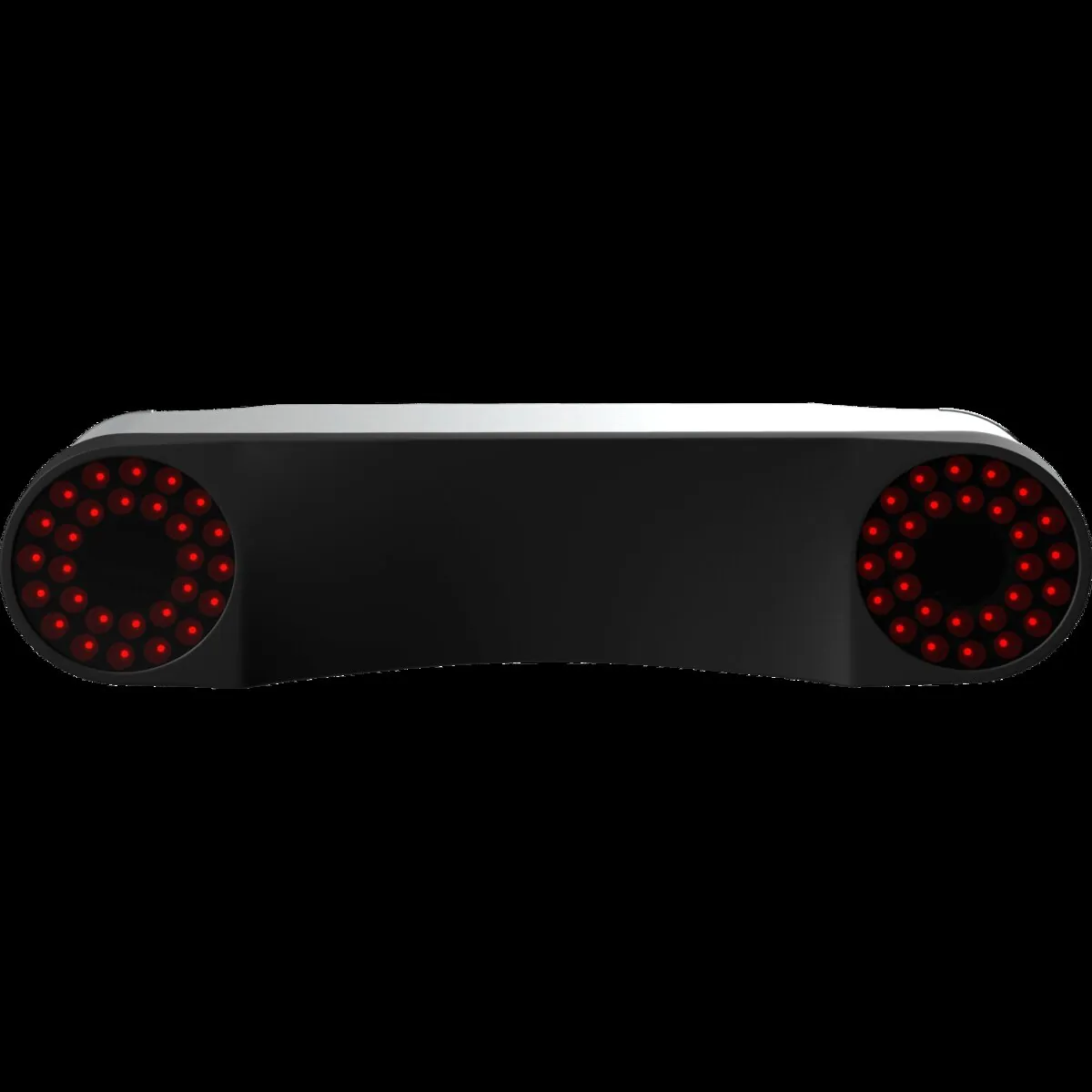
Both are ceiling-mounted, dual-camera launch monitors with zero subscription fees, 24 data points, and full GSPro integration.
One costs $5,000 and has the biggest hitting zone in the entire overhead class. The other costs $6,500 and includes two swing cameras in the box with a more mature software platform.
This is VTrack vs ProTee VX — the two most interesting value propositions in overhead simulation right now. I’ve spent time with both reviews (full VTrack review, full ProTee VX review) and have a clear take on which one wins for different buyers.
Let me just lay it out.
The TL;DR
| VTrack | ProTee VX | |
|---|---|---|
| Price | $5,000 | $6,500 |
| Technology | Dual stereoscopic cameras + IR | Dual stereoscopic cameras |
| Frame rate | 1,800 FPS | 1,200 FPS |
| Hitting zone | 31“ × 24“ (744 sq in) | 25“ × 21“ (525 sq in) |
| Data points | 23+ (all measured) | 24 (all measured) |
| Club data stickers? | No — markerless | No — markerless |
| Ball tracking | Dimple + IR (no marked balls) | Dimple pattern (no marked balls) |
| Subscription | $0 — never | $0 — never |
| Swing cameras | None included | Two included ($600 value) |
| Ceiling height | 8’10“ min (106“) | 9’0“ min |
| Left/right switching | Instant | Instant |
| Response time | 200-250 ms | Under 300 ms |
| GSPro support | Native ($0) | Native ($0) |
| E6 Connect | Native | Third-party connector (~$300) |
| Native software | VTrack Dashboard (basic) | ProTee Labs (feature-rich) |
| Best for | Value-focused overhead buyers | Buyers who want swing cameras included |
VTrack wins on price, hitting zone size, frame rate, and ceiling height minimum. ProTee VX wins on included accessories and software maturity.
The Price Gap: $1,500
Let’s start with the number that matters most.
The VTrack costs $5,000. The ProTee VX costs $6,500. That’s a $1,500 difference — 23% less for the VTrack.
Both have zero subscription fees. Neither asks for a dime after the upfront purchase. That’s rare in the overhead category and worth calling out for both of them. (See our best no-subscription launch monitors guide for more on why this matters.)
But here’s where the math gets interesting. The ProTee VX includes two swing cameras valued at roughly $600 (that’s what comparable cameras would cost from Uneekor or as third-party add-ons). If you were going to buy those anyway, the ProTee VX’s effective price drops to about $5,900 if you value them at full retail — narrowing the gap to $900.
If you don’t care about swing cameras (and a lot of people don’t — they just want the launch monitor data), the $1,500 gap is real and substantial.
5-year cost comparison:
| VTrack | ProTee VX | |
|---|---|---|
| Upfront | $5,000 | $6,500 |
| Swing cameras | $0 (not included) | Two included ($600 value) |
| Software (5 years) | $0 | $0 |
| GSPro connection | $0 | $0 |
| Effective 5-year total | $5,000 | $6,500 |
No subscriptions on either side. The VTrack saves you $1,500 minimum.
The Hitting Zone: VTrack Dominates
The VTrack’s hitting zone is 31 inches by 24 inches — 744 square inches. The ProTee VX’s is 25 inches by 21 inches — 525 square inches.
That’s 42% more tracking area on the VTrack.
For context:
- VTrack: 744 sq in (31“ × 24“)
- ProTee VX: 525 sq in (25“ × 21“)
- Uneekor EYE XO: 162 sq in (13.7“ × 11.8“)
- Uneekor EYE XO2: 588 sq in (28“ × 21“)
The VTrack has the largest hitting zone in the entire overhead launch monitor category. Not “for the price” or “in its class” — just the largest.
What this means in real life: with the VTrack, you place the ball anywhere in that massive rectangle and the cameras find it instantly. Moving ball position for different clubs — forward for driver, middle for irons, back for wedges — doesn’t require a single thought about whether you’re in the tracking area. It’s always in the tracking area.
The ProTee VX’s 525 square inches is still generous. It’s bigger than most overhead competitors. But compared to the VTrack, you’ll find the edges faster, especially if you’re sharing with other golfers who have different stances and ball positions.
Frame Rate: Faster Is Better
The VTrack captures at 1,800 frames per second. The ProTee VX captures at 1,200 FPS. That’s 50% more images per second from the VTrack.
Higher frame rate means more data points during the 2-3 milliseconds the ball is in the hitting zone. More data points mean more accurate spin measurements, more precise club path tracking, and more consistent read-to-read repeatability.
Is the difference between 1,200 and 1,800 FPS noticeable to the average home golfer? Probably not on most shots. But on wedge shots with high spin rates, on partial swings, and on shots where the ball is slightly off-center, the extra frames give the VTrack more data to work with. It matters on the margins, and on a $5K+ purchase, the margins are where the value lives.
Swing Cameras: The ProTee VX’s Best Feature
This is where the ProTee VX fights back.
The VTrack does not include swing cameras. You can add your own (any USB camera works with the VTrack Dashboard for swing video sync), but it’s not in the box, it’s not calibrated, and it’s not integrated the way the ProTee system is.
The ProTee VX includes two high-speed swing cameras — face-on and down-the-line — that sync directly with the VX’s timing system. After every shot, you get a slo-mo replay of your swing with data overlay showing club path, face angle, and the exact moment of impact. ProTee Labs even has a Ball Spin Validator that shows tracking dots following the ball’s logo in slow motion.
If you care about swing mechanics and want video analysis built into your launch monitor experience, this is the ProTee VX’s strongest argument. Adding comparable cameras to the VTrack would add $200-400 and require manual integration.
If you don’t care about swing video — you just want the numbers and the sim round — this doesn’t matter at all. The VTrack gives you the numbers faster, with a bigger hitting zone, for $1,500 less.
Software: Mature Ecosystem vs New Contender
The ProTee VX runs on ProTee Labs — a purpose-built practice platform with serious analytics tools. Bag mapping, wedge matrix, clubface heatmaps, dispersion circles, shot recording with video sync, dual-screen support, user profiles — it’s the kind of software that turns a launch monitor into a coaching system. ProTee United has been updating it aggressively, adding 3D skeleton tracking and the Ball Spin Validator in recent months.
The VTrack runs on the VTrack Dashboard — a functional but basic software interface. It shows your data, replays swing video (if you add a camera), and tracks sessions. It does the job. But it’s not in the same league as ProTee Labs for training analytics.
Most VTrack owners report using GSPro as their primary interface and only opening the dashboard for detailed data review. And honestly? That’s what I’d do too. GSPro is where the course play happens, and both units connect to it natively with zero additional fees.
The software difference matters if:
- You want a complete training ecosystem without needing third-party tools
- You care about video analysis synced to your data
- You want bag mapping and wedge matrix tools built in
The software difference doesn’t matter if:
- You mostly play GSPro courses and only check data occasionally
- You already have a separate swing analysis setup
- You’re comfortable using GSPro’s practice tools
Ceiling Height: VTrack Wins by 2 Inches
The VTrack requires a minimum ceiling height of 106 inches (8 feet 10 inches). The ProTee VX requires 108 inches (9 feet) minimum, with 10 feet recommended.
Two inches doesn’t sound like much. But if you have a garage or basement with 9-foot ceilings, the difference between “works” and “you’re cutting it too close” matters. The VTrack’s 106-inch requirement opens up more rooms — rooms where the ProTee VX’s 108-inch minimum feels tight.
Both units mount about 40 inches in front of the hitting area. Both look down at a specific spot. Both require stud-finder-and-drill installation.
Neither works with standard 8-foot ceilings. If that’s what you have, you’re looking at floor-based units like the SkyTrak+, Uneekor Eye Mini, or GC3. (Our overhead vs floor guide covers the full decision tree.)
Installation: They’re the Same
Both units are 18 pounds. Both mount to ceiling joists. Both require running a Cat6 cable and finding a power source near the ceiling.
Installation time for both: 2-4 hours DIY, or $200-400 for a pro. Both come with mounting hardware. Both stay calibrated after initial setup.
There’s nothing here that separates them. If you can install one, you can install the other.
Brand Trust: ProTee Wins (For Now)
ProTee United created TGC 2019 — the most popular simulator software in the world. They’ve been in golf simulation since 2001. The VX is their first hardware product, but they have decades of software credibility and a passionate user community.
Laon Swingcraft has been doing machine vision and AI since 2010. Their VTrack has sold 20,000+ units in South Korea with strong owner reviews and consistent firmware updates. But in the US market, they’re still building brand awareness, retailer relationships, and community support.
If something goes wrong with your ProTee VX, there are forum threads, YouTube tutorials, and a customer support team that speaks English natively. If something goes wrong with your VTrack… the support is there (I’ve heard good things), but the community resources are thinner.
This matters for some buyers more than others. If you’re comfortable being an early adopter and don’t need a massive troubleshooting forum, the VTrack is fine. If you want the peace of mind of a well-established ecosystem, the ProTee VX has the edge.
The Verdict: VTrack Wins on Value, ProTee VX Wins on Features
Here’s where I land.
Buy the VTrack if:
- You want the largest hitting zone in the entire overhead category
- You want to save $1,500 minimum
- You don’t need included swing cameras
- You have 8’10“ to 9’0“ ceilings (the VTrack fits where the ProTee VX doesn’t)
- You’re comfortable with a newer brand and a basic dashboard (you’ll use GSPro anyway)
- Higher frame rate matters for your use case
Buy the ProTee VX if:
- You want two swing cameras included in the box
- You value ProTee Labs’ training analytics over a bigger hitting zone
- You want the longer track record and larger US community
- You need E6 Connect support without a $300 adapter
- You have 9+ foot ceilings and want the more polished software
For the vast majority of overhead buyers, the VTrack is the better value. A $5,000 ceiling-mounted launch monitor with a 31-by-24-inch hitting zone, 1,800 FPS cameras, and zero subscription fees is the best deal in overhead simulation right now. The ProTee VX is a better product in specific ways (swing cameras, software polish, brand trust), but it’s $1,500 more.
If you don’t care about swing cameras and you’re happy using GSPro as your primary interface (which most people are), the VTrack is the smarter purchase. That $1,500 can buy you a GSPro subscription for six years and a very nice BenQ projector.
If you want swing cameras built in and the full ProTee Labs training ecosystem, the ProTee VX is worth the premium. It’s the more complete package out of the box.
Both are excellent. Both have zero subscription fees. Both are the best values in their respective roles. Pick the one that matches how you actually use your simulator.
Check the VTrack at Golf Bays USA — $5,000, in stock, free shipping. Also at Elite Sim Golf and Golf Simulators Direct.
Check the ProTee VX at Top Shelf Golf — $6,500, includes two swing cameras, ships from the Netherlands in 2-3 days. Also at Golf Simulators Direct and PlayBetter.
More overhead LM comparisons: Best Overhead Launch Monitors (2026) — full roundup · 7 Overhead LMs Compared — spec-by-spec · ProTee VX vs Uneekor EYE XO · VTrack Review · ProTee VX Review · Overhead vs Floor LM Guide
Need the full picture on costs? 5-Year Total Cost of Ownership → with software subscriptions, mats that wear out, and the hidden expenses nobody talks about.