
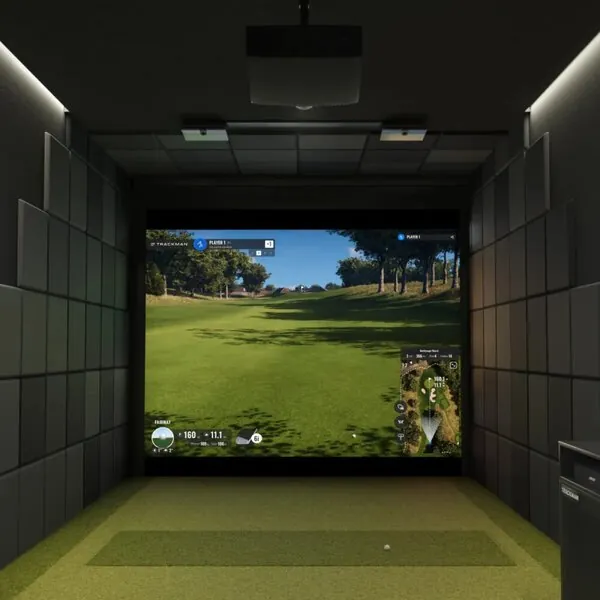
One costs $13,995. The other costs $4,999. Both track golf shots with enough accuracy to satisfy serious players. Both come from companies with deep golf pedigrees.
The Trackman iO is the ceiling-mounted home version of the tour-standard Trackman. The Garmin Approach R50 is a portable all-in-one simulator with a built-in touchscreen. They’re the two best launch monitors in the premium tier — and they represent completely different philosophies about what a home simulator should be. For a broader look at the premium LM market, see our best golf simulators under $5,000 guide and best overhead launch monitors guide.
Let’s figure out whether Trackman’s $9,000 premium is worth it.
The Quick Version
| Trackman iO | Garmin R50 | |
|---|---|---|
| Price | $13,995 | $4,999 |
| Technology | Optically Enhanced Radar (radar + infrared + high-speed imaging) | 3 high-speed cameras |
| Placement | Ceiling-mounted | Floor unit, beside the ball |
| Portability | None — permanent install | Fully portable (9 lbs) |
| Room depth needed | None — no minimum depth | Standard camera depth (~10 ft) |
| Spin measurement | Measured 3D spin (full three-dimensional) | Measured spin (camera-based, 2D) |
| Courses included | 50 (Home edition) | 43,000+ (Home Tee Hero) |
| Software | Trackman Performance Studio | Garmin Golf + Home Tee Hero |
| Subscription | $700/year after year 1 | $99/year (Garmin Golf membership) |
| Built-in display | No (requires connected screen) | Yes — 10-inch touchscreen |
| Battery | No (hardwired) | 4 hours (sim mode), 10 hours (data only) |
| Left/right switching | Automatic (ceiling mount) | Manual repositioning |
Technology: Two Different Approaches to “Premium”
This is the core difference, and it’s fascinating.
Trackman iO uses what they call Optically Enhanced Radar Tracking. That’s not marketing fluff — it’s a genuine hybrid system. The iO combines:
- Doppler radar (tracks ball flight)
- Infrared light (tracks the club through impact)
- High-speed imaging (captures the moment of strike)
All three systems fire simultaneously and fuse their data. The result: measured 3D spin axis. Not estimated. Not 2D. Full three-dimensional spin data — the kind of thing club fitters on the PGA Tour use.
Garmin R50 uses three high-speed cameras. It’s a photometric system — it watches the ball at impact, reads the dimple pattern, and calculates spin from rotation. This is the same technology class as the Bushnell Launch Pro and Foresight GC3, just with three cameras instead of two.
Both approaches are excellent. The Trackman iO’s fusion of radar + optical is more comprehensive — it sees the ball at impact AND tracks it in flight. The R50’s camera system sees the ball at impact only, but does it with three lenses for better accuracy than two-camera systems.
For spin: Trackman measures 3D spin. The R50 measures 2D spin (backspin and sidespin, but not the full three-dimensional axis). In practice, this matters for tour fitters and low-handicap players who care about spin axis tilt. For a 12-handicap who wants to know if his 7-iron spins 7,000 or 7,200 RPM, the difference is academic.
Accuracy: How Close Are They?
Trackman is the benchmark. Every other launch monitor on earth is compared to Trackman. So the question isn’t “is Trackman accurate?” — it’s “how close does the R50 get?”
Ball speed: Both within 0.5-1% of each other. Negligible.
Launch angle: Both accurate. The R50’s three-camera array handles this well. Trackman’s radar + optical fusion handles it better on mishits.
Spin: Trackman measures 3D spin directly. The R50 measures 2D spin from camera images. On well-struck shots, they agree within 200-400 RPM. On mishits and unusual spin axes (big cuts, trap draws), Trackman pulls ahead because it captures the full 3D rotation.
Club data: Trackman’s infrared system captures club path, face angle, angle of attack, and club speed with precision. The R50 uses its cameras for club data (with shaft markers) and is good but not Trackman-level on the granular stuff.
Verdict: Trackman is more accurate. But “more accurate” in this tier means the difference between 99.2% and 99.8%. If you’re a PGA Tour player being fitted for clubs, that matters. If you’re a weekend golfer trying to tighten your dispersion, the R50 is more than enough.
Software: Trackman Performance Studio vs Home Tee Hero
This is where the $9,000 gap starts to make sense.
Trackman Performance Studio is the best simulation software in golf. Period. It’s what tour players use. The course renderings are stunning. The data presentation is world-class. The practice modes — target practice, dispersion analysis, stroke play with real-time data overlays — are genuinely tools for improvement, not just entertainment.
50 courses are included with the Home edition. They’re real courses, rendered with elevation data and satellite imagery. Pebble Beach, St. Andrews, PGA National — the big names.
But: the software requires a $700/year subscription after year 1. Stop paying, lose access to the simulator features. You keep basic data, but the courses and advanced practice tools go away.
Garmin Home Tee Hero includes 43,000+ courses. That’s not a typo — forty-three thousand. It uses a different rendering approach (more map-based than photorealistic), so the courses don’t look as good as Trackman’s or GSPro’s. But 43,000 vs 50 is a massive library difference.
The R50’s 10-inch touchscreen means you can play without a separate screen — the device itself is the interface. That’s genuinely convenient for a portable setup. Trackman requires a connected display (TV, projector, monitor).
Garmin Golf membership is $99/year for simulator play. That’s 7x cheaper than Trackman’s subscription.
The Space Question: Trackman’s Secret Weapon
Here’s something most comparison articles miss: the Trackman iO has no room depth requirement.
Most launch monitors need space. Radar units (Mevo+, R10) need 16-20 feet of total depth. Camera units (SkyTrak+, R50) need the ball to travel far enough for the cameras to read it — usually 10-12 feet minimum.
The Trackman iO is ceiling-mounted. It sits overhead. It uses radar to track ball flight AND optical imaging to capture impact, which means it works in rooms where the ball barely travels before hitting the screen. You can put a Trackman iO in a 10-foot-deep room and it works perfectly.
This is huge for people with tight spaces. If your garage is 10 feet deep and every other premium launch monitor needs 12+, the Trackman iO is the only option that works. That alone justifies the price for some buyers.
The R50 needs standard camera depth — about 10 feet of ball flight. It works in most garages and basements, but it’s not as forgiving as the iO in truly tight spaces.
Portability: The R50’s Biggest Advantage
The Trackman iO is a permanent installation. It mounts to your ceiling. Once it’s up, it’s up. You can’t take it to a friend’s house. You can’t use it at the range. You can’t move it when you sell the house (well, you can, but it’s a project).
The Garmin R50 is a 9-pound portable device. Take it anywhere. Use it in the garage, the basement, the backyard (it’s IPX3 water-resistant), or a hotel room on a business trip. The built-in battery lasts 4 hours in full simulator mode.
If you rent, move frequently, or want a device that travels — the R50 is the obvious choice. The iO is for homeowners with a dedicated space.
Subscription Costs Over 5 Years
| Trackman iO | Garmin R50 | |
|---|---|---|
| Year 1 | $13,995 (software included) | $4,999 + $99 = $5,098 |
| Years 2-5 | $700 × 4 = $2,800 | $99 × 4 = $396 |
| 5-year total | $16,795 | $5,494 |
Over 5 years, the Trackman costs $11,301 more than the R50. That’s a Foresight GC3 and a full enclosure. Or a used car. Or a family vacation to Scotland to play real golf.
The subscription gap is real. $700/year vs $99/year is a 7x difference. If you’re subscription-averse (and a lot of you are), the R50’s lower recurring cost is a significant factor.
Who Should Buy What
Buy the Trackman iO if:
- You have a dedicated simulator room and want the ceiling mounted
- Your room is too shallow for other premium units (under 12 feet deep)
- You want the absolute best accuracy available for a home system
- You want Trackman Performance Studio (the best simulation software)
- You’re a low-handicap player or aspiring competitive golfer
- $700/year subscription doesn’t bother you
- You’re a homeowner who isn’t moving anytime soon
Buy the Garmin R50 if:
- You want a portable device you can use anywhere
- You want a built-in screen (no separate display required)
- You want 43,000+ courses (even if they’re not as pretty)
- $4,999 is your ceiling, not $14,000
- You want lower subscription costs ($99/year vs $700/year)
- You rent, move, or want to take it to the range
- You want one device that does indoor sim + outdoor practice
The Verdict
Trackman is better. Nobody who has used both would argue otherwise. The iO’s accuracy, software, and space flexibility are genuinely superior. If money is no object and you have a permanent space, buy the Trackman.
But money is an object for most people. And the Garmin R50 delivers 90% of the Trackman experience for 36% of the price. It’s portable. It has a screen. It has 43,000 courses. The subscription is 7x cheaper.
Most people reading this site don’t need the Trackman. They need a great launch monitor that works in their garage, doesn’t require a second mortgage, and lets them play Pebble Beach in January. The R50 does all of that.
Winner: Trackman iO (on merit — it’s the better device). Smart buy: Garmin R50 (on value — it’s the right device for 95% of buyers).
If you have $14,000 and a permanent room, buy the Trackman. If you have $5,000 and a garage, buy the R50. Both are excellent. Only one requires a conversation with your spouse first.
Read the full reviews: Trackman iO review and Garmin R50 review. Or check out our best golf simulators under $5,000 guide for more premium options. For space planning, the golf simulator space requirements guide has everything you need.
Need the full picture on costs? 5-Year Total Cost of Ownership → with software subscriptions, mats that wear out, and the hidden expenses nobody talks about.