
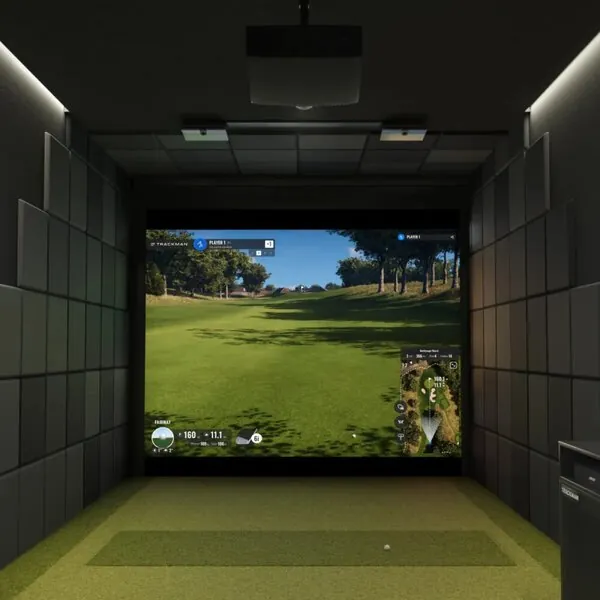
This is the comparison that every forum argument eventually arrives at. The $14,000 ceiling-mounted radar unit versus the $1,495 floor-mounted camera. The Tour pro’s training tool versus the garage guy’s launch monitor. The “I have a sim business” purchase versus the “I have a Christmas bonus” purchase.
Let’s settle it.
The Two Units
Trackman iO is Trackman’s home simulator offering. It’s a ceiling-mounted radar unit that uses the same radar technology Trackman built its reputation on — the same tech you see at PGA Tour events, in Tour vans, and at every high-end fitting facility. The iO is Trackman’s attempt to bring that technology into the home market. Price: $13,995 (including installation).
SkyTrak+ is the successor to the original SkyTrak — the launch monitor that basically created the home simulator market. It’s a photometric camera unit that sits on the floor behind the ball and reads the ball’s flight using high-speed cameras. Price: $1,495.
These are completely different technologies solving the same problem. Radar versus camera on the tech front, ceiling versus floor on the mounting front, $14K versus $2K on the price front. The question is which one is better for you, not which one is better on paper.
Accuracy: The Core Question
This is what everyone wants to know. Does the Trackman iO’s $14,000 radar actually read shots more accurately than the SkyTrak+’s $1,495 camera?
Short answer: Yes, but not by as much as you’d think for the price gap.
Long answer:
The Trackman iO uses Doppler radar to track the ball’s entire flight. It measures ball speed, launch angle, spin rate, spin axis, carry distance, and total distance by physically tracking the ball through the air. This is the gold standard — it’s what Tour pros trust because it measures the actual ball flight, not a prediction based on the first few inches.
The SkyTrak+ uses photometric cameras to capture the ball’s first few inches of flight, then calculates the rest. It measures ball speed, launch angle, backspin, sidespin, and club data from that initial flight window. The math is good — really good — but it’s still a prediction based on a snapshot, not a measurement of the full flight.
Where the iO pulls ahead:
-
Spin axis tilt. The iO measures actual spin axis by tracking the ball’s flight. The SkyTrak+ calculates spin axis from the spin data it captures at impact. In testing, the iO’s spin axis readings are more consistent on curved shots (draws, fades, big slices) because it sees the curve happen. The SkyTrak+ can struggle with extreme spin axis values — shots that curve a lot sometimes read straighter than they actually are.
-
Carry vs total distance. Because the iO tracks the full ball flight, its carry and total distance numbers are measured, not predicted. The SkyTrak+ calculates carry from the initial flight data. For most shots, the difference is 2-5 yards. For unusual shots — high launch with low spin, or low launch with high spin — the gap can be larger.
-
Club data. The iO measures club path, face angle, and attack angle directly through radar. The SkyTrak+ estimates club data from ball data. If you want to know your actual club path (not an estimate), the iO is the answer.
Where they’re basically equal:
- Ball speed. Both units measure ball speed accurately. The difference is less than 1 mph in testing.
- Launch angle. Both units measure launch angle within 0.5 degrees.
- Backspin. Both units measure backspin within 200-300 RPM on well-struck shots. The SkyTrak+ can struggle on mishits and partial shots.
Where the SkyTrak+ has an edge:
-
Indoor accuracy at short distances. The iO needs ball flight to read — it’s a radar, and radar needs space. In a tight garage with 10 feet of ball flight, the iO has less data to work with. The SkyTrak+ reads the ball at impact and in the first few inches, so it doesn’t need ball flight distance. In a 10-foot-deep garage, the SkyTrak+ can actually be more consistent than the iO.
-
Putting. The SkyTrak+ handles putting (with the right software). The iO does not track putts. If putting is important to your sim experience, this is a significant difference. Read more about putting on simulators here.
Technology: Radar vs Camera
This is the camera vs radar debate in its purest form.
Trackman iO (Radar):
- Ceiling-mounted, 10 feet up
- Tracks ball flight through the air
- Needs 10+ feet of ball flight for accurate readings
- Immune to lighting conditions (radar doesn’t care about light)
- No metal dots required on the ball (unlike older Trackman units)
- Measures club data directly
SkyTrak+ (Camera):
- Floor-mounted, behind the ball
- Reads ball at impact and initial flight
- Works in as little as 6-8 feet of depth
- Needs decent lighting (cameras need light)
- No metal dots required
- Estimates club data from ball data
The tech choice is also a space choice. If you’ve got a deep room (15+ feet), the iO has enough ball flight to shine. If you’re in a tight garage (10-12 feet), the SkyTrak+ is actually in its element and the iO is slightly handicapped.
Software: Trackman Simulator vs SkyTrak’s Ecosystem
Trackman iO comes with Trackman Simulator software — the same virtual courses and practice range you see on Trackman units at commercial facilities. The software is included with the purchase. You get:
- Trackman Virtual Golf (dozens of courses, including real Tour venues)
- Trackman Practice (range session with full data)
- Trackman Test Center (skills challenges, combine tests)
- Online multiplayer via Trackman’s network
The software is genuinely excellent. The course rendering is top-tier, the data presentation is clean, and the multiplayer experience is the best in the business. But it’s a closed ecosystem — you’re locked into Trackman’s software. You can’t run GSPro or E6 Connect on the iO.
SkyTrak+ connects to third-party software via a network connection. You can run:
- GSPro (the community favorite — thousands of courses, active online play)
- E6 Connect (premium courses, official licensed content)
- TGC 2019 (older but huge course library)
- SkyTrak’s own app (free with basic features, $99-199/year for advanced)
The SkyTrak+ gives you software freedom. You’re not locked into one ecosystem. Note: GSPro requires a community connector now (not officially supported), but the bridge app works well. If you want to switch to E6 Connect next year, you can. The iO is what it is — Trackman’s software, forever.
The cost difference here is massive: Trackman’s software is included but the hardware costs $14K. SkyTrak+ hardware is $1,495, but you’ll pay $100-300/year for premium software (GSPro is $250/year, E6 Connect varies). Over 5 years, SkyTrak+ total cost: $1,495 + $1,250 (GSPro for 5 years) = $2,745. Trackman iO total cost: $13,995. The software subscription math matters.
Mounting: Ceiling vs Floor
The iO is ceiling-mounted. The SkyTrak+ is floor-mounted. This isn’t a minor difference — it changes your entire setup.
iO ceiling mount:
- Permanent installation (must be done by certified installer)
- Out of the way — no floor clutter, nothing to bump
- Needs 9-11 foot ceilings
- Set-and-forget alignment (once it’s calibrated, it stays)
- Not portable — it lives in one room forever
SkyTrak+ floor mount:
- Sits on the floor behind the ball
- Portable — you can move it to a different room or take it to a friend’s house
- Works with any ceiling height
- Needs periodic realignment (vibration and bumps can shift it)
- Takes up floor space — you need room for the unit behind your hitting position
Read our full launch monitor mounting guide for details.
The ceiling mount is a feature, not a bug, for the iO’s target buyer. If you’re spending $14K on a launch monitor, you want a permanent installation that looks clean and never needs adjustment. The SkyTrak+’s portability is a feature for its target buyer — the guy who might move, might rearrange his garage, might want to take the unit to the range.
Price: The Elephant in the Room
| Trackman iO | SkyTrak+ | |
|---|---|---|
| Hardware | $13,995 | $1,495 |
| Software (5 years) | Included | ~$1,250 (GSPro) |
| Installation | Included | DIY (free) |
| Total 5-year cost | $13,995 | $2,745 |
| Difference | — | $10,550 cheaper |
The iO costs 4.5x more than the SkyTrak+ over 5 years. Is it 4.5x better? No. It’s maybe 15-20% better on accuracy, significantly better on software polish, and better on mounting convenience. But the value proposition of the SkyTrak+ is absurd — you get 85% of the accuracy for 16% of the price.
Who Should Buy the Trackman iO
- You have $14K sitting around and the purchase won’t cause any financial stress
- You want Tour-level data accuracy and club measurement
- You want a permanent, ceiling-mounted installation that looks professional
- You want the best software ecosystem in golf (Trackman’s courses and multiplayer)
- You’re a low-handicap golfer who cares about spin axis and club path data
- You might use it for club fitting or coaching
Who Should Buy the SkyTrak+
- You want an excellent launch monitor for $1,495
- You want software freedom (GSPro, E6, TGC — your choice)
- You want a portable unit you can move or take to the range
- You have a tight space (10-12 feet of depth) where radar struggles
- You want to putt on your simulator (the iO doesn’t track putts)
- You’d rather spend the $10,550 difference on a better enclosure, a nicer projector, and a better mat
The Verdict
The Trackman iO is the better launch monitor. It’s more accurate, the software is better, the ceiling mount is cleaner, and the data is Tour-level. If money is no object and you want the best home simulator experience money can buy, the iO is the answer.
But money is an object. For 95% of home sim builders, the SkyTrak+ is the smarter purchase. It delivers 85% of the accuracy at 16% of the price. It gives you software freedom. It works in tight spaces. It tracks putts. And the $10,550 you save buys a lot of other simulator upgrades — or a family vacation, or a college fund contribution, or whatever your wife would prefer you spend it on.
The iO is the dream. The SkyTrak+ is the reality. And the reality is pretty damn good.
Winner: Trackman iO (on merit) | Smart buy: SkyTrak+ (on value)
Compare the SkyTrak+ to other mid-range options or see our full SkyTrak+ review.
Need the full picture on costs? 5-Year Total Cost of Ownership → with software subscriptions, mats that wear out, and the hidden expenses nobody talks about.