
Two launch monitors. Both use cameras to measure ball data at impact. Both give you measured spin, not estimated.
One costs $1,499. The other costs $4,999.
Same core technology. $3,500 price gap. The question isn’t “which is better” — it’s “which one matches what you already have and what you’re trying to build.”
Let me break it down.
The Quick Version
| Uneekor EYE MINI CORE | Garmin Approach R50 | |
|---|---|---|
| Price | $1,499 | $4,999 |
| Technology | Camera + infrared | 3 high-speed cameras (triscopic) |
| Built-in screen | No No — needs a PC | Yes 10“ color touchscreen |
| Onboard simulation | No No — needs PC + software | Yes Home Tee Hero (43,000+ courses) |
| PC required | Yes Yes — Windows only | No No |
| Battery | No A/C power only | Yes 4 hours (sim), 10 hours (data) |
| Portability | Semi-portable (needs laptop) | Fully portable |
| Software | GSPro, E6, TGC 2019, Creative Golf | Home Tee Hero, GSPro, E6, Awesome Golf |
| Subscription needed | $199/yr for GSPro (Uneekor Pro) | $99/yr (Garmin Golf for Home Tee Hero) |
| Weight | ~3 lbs | 9 lbs |
| Outdoor use | Yes Yes (with laptop) | Yes Yes (IPX3 water resistant) |
The R50 wins as a complete simulator in one box. The EYE MINI wins on raw price — it’s the cheapest camera-based launch monitor that delivers real accuracy, if you already have the rest of the setup.
The $3,500 Question
Here’s what you’re paying for with the R50 that the EYE MINI doesn’t have:
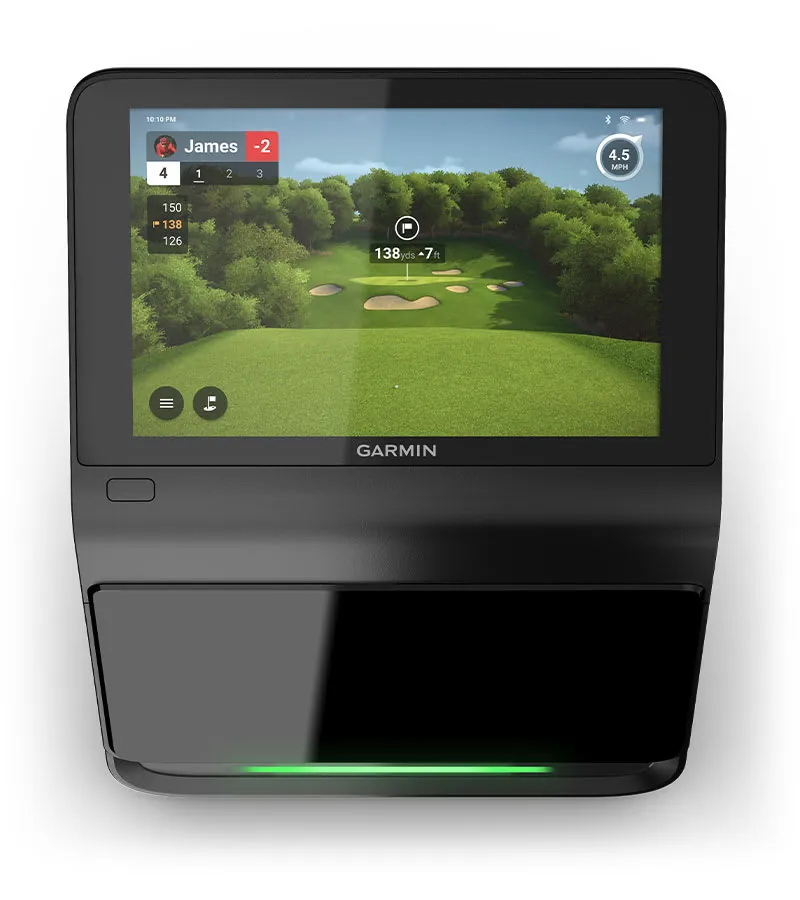
A built-in 10-inch touchscreen. This is the R50’s killer feature. It’s a complete simulator with a screen — no phone propped on a bucket, no gaming PC humming in the corner, no iPad mount. You set it on the floor, turn it on, and play Pebble Beach. The EYE MINI has no screen. It’s a black box that connects to a computer. You need a display — projector, monitor, TV — and a PC to run the software.
43,000+ courses on-device. The R50 runs Home Tee Hero natively. You select a course on the touchscreen and start playing. The EYE MINI needs GSPro or E6 running on a Windows PC. More setup, more moving parts, more troubleshooting when something doesn’t connect.
A battery. The R50 runs for 4 hours in simulator mode on battery. You can play in your garage, your backyard, or the driving range without plugging in. The EYE MINI needs wall power and a computer tethered to it. It’s “portable” in the sense that you can carry it to a different room — but you need to set up the whole system again.
Impact video. The R50 captures automatic slow-motion impact video — black and white, but you can see the club hit the ball. The EYE MINI doesn’t include this natively (you’d need the Swing Optix add-on camera, which is extra).
So the question is: do you already have a gaming PC and a display?
If yes — you’ve got a $1,500 Windows machine and a projector or TV already — the EYE MINI at $1,499 is a staggering value. You’re getting camera-based measured spin at a price point that used to mean “radar with estimated everything.”
If no — you’re starting from scratch and don’t own a PC — the R50 at $4,999 is actually the better deal. Because the R50 is the computer. Buying an EYE MINI ($1,499) + gaming PC ($1,200) + display/projector ($500) = $3,199 minimum, and you still don’t have a battery, onboard simulation, or a touchscreen.
Technology: Both Cameras, Different Approaches
Both launch monitors use photometric technology — cameras that capture the ball at impact and measure spin directly from the ball’s rotation.
The EYE MINI uses camera + infrared. Uneekor’s Dimple Optix technology reads the ball’s actual dimple pattern — no marked balls required. You can use any ball. The infrared system handles low-light conditions, so it works in a dimly lit garage. It measures 15 ball metrics with instant feedback and near-zero shot delay.
The R50 uses three high-speed cameras — a triscopic system similar to the Foresight GC3. Three cameras fire at impact from multiple angles and capture ball speed, launch angle, spin rate, spin axis, and club data. It also captures impact video.
In practice, both are accurate to within 1-3% of each other on ball speed, launch angle, and carry distance. The differences are in edge cases:
| Situation | EYE MINI | Garmin R50 |
|---|---|---|
| Perfect conditions | Excellent | Excellent |
| Dim garage | Good (infrared helps) | Good (needs decent light) |
| Hitting zone tolerance | Generous | 7“ x 10“ (focused) |
| Tight spaces (8 ft depth) | Yes Works (sits beside ball) | Yes Works (sits beside ball) |
| Putting | Yes Via software | Yes Native |
| Club data | Needs Swing Optix add-on | Yes Included |
| Lefty/righty switch | Move unit to other side | Move unit to other side |
Both sit beside the ball — neither needs the 16+ feet of depth that radar units like the Mevo+ or Full Swing KIT require. If you’ve got a tight garage or basement, both work.
One key difference: the R50 includes full club data (face angle, club path, angle of attack) out of the box. The EYE MINI gives you ball data natively, but club data requires the Swing Optix add-on camera — an extra cost that narrows the price gap.
Software: Ecosystem vs All-in-One
EYE MINI software ecosystem:
- View software (free, basic range work)
- GSPro ($250/year, but requires Uneekor Pro subscription at $199/year — so $449/year total if you want GSPro)
- E6 Connect (various packages)
- TGC 2019
- Creative Golf 3D
The EYE MINI is an open ecosystem. It connects to everything. If you want 4,000+ GSPro courses, Augusta, St. Andrews, and your local muni modeled by a community nerd — the EYE MINI gets you there. But you need the PC, the subscriptions, and the willingness to troubleshoot connection issues.
R50 software ecosystem:
- Home Tee Hero (included, 43,000+ courses, $99/year Garmin Golf membership)
- GSPro ($250/year, runs from PC — wireless connection to R50)
- E6 Connect
- E6 Apex
- Awesome Golf
The R50’s Home Tee Hero is the most frictionless simulator software in existence. Turn it on, pick a course, play. 43,000 courses is absurd. The graphics aren’t as photorealistic as GSPro — they look more like a PS4 game than a 4K render — but they’re good enough, and the course count is unbeatable.
If you want GSPro on both, the R50 connects wirelessly — select GSPro on the R50’s screen, connect your PC to the R50’s WiFi hotspot, and you’re in. The EYE MINI connects via USB to the same PC.
Here’s the honest subscription math:
| EYE MINI CORE | Garmin R50 | |
|---|---|---|
| Year 1 hardware | $1,499 | $4,999 |
| Year 1 software | $0 (View) or $449 (GSPro + Uneekor Pro) | $99 (Garmin Golf) |
| Year 5 total (with GSPro) | $1,499 + $2,245 = $3,744 | $4,999 + $495 = $5,494 |
| Year 5 total (basic) | $1,499 | $5,494 |
With GSPro on both, the EYE MINI is still $1,750 cheaper over 5 years. Without GSPro — just basic included software — the gap is $4,000 in the EYE MINI’s favor. But the R50 gives you 43,000 courses on-device for that $99/year, while the EYE MINI’s free View software is range-only.
Portability
R50: 9 pounds, 4-hour battery, built-in screen. Fully portable. You can play simulator golf in your backyard on battery power. The carrying case is large (reviewers compare it to a Yeti cooler), but it’s genuinely grab-and-go.
EYE MINI: ~3 pounds, no battery, no screen. You can carry the unit easily, but you need to also carry a laptop, find power, and connect cables. It’s portable in the sense that you can move it. It’s not portable in the sense that you will move it often.
If portability matters, the R50 is the clear winner. If the unit lives in your garage forever, this doesn’t matter.
Who Should Buy What
Buy the Uneekor EYE MINI CORE if:
- You already have a gaming PC (or you’re willing to buy one)
- You want the cheapest camera-based launch monitor with measured spin
- You want GSPro’s 4,000+ course library and are okay with the subscription stack
- You’re a DIY builder who doesn’t mind setup and troubleshooting
- $1,499 is your ceiling, not $4,999
- You want to start with a quality launch monitor and upgrade the enclosure/projector later
Buy the Garmin Approach R50 if:
- You want a complete simulator in one box — no PC, no tablet, no phone
- The built-in 10-inch touchscreen matters to you (it should — it’s genuinely great)
- You want 43,000 courses without GSPro setup headaches
- You want battery-powered portability — backyard, range, garage, buddy’s house
- You want impact video built in
- You want full club data included, not behind an add-on
- $4,999 is within your budget and you’d rather pay once than assemble a system
The Real Answer
The EYE MINI is the value play. It’s the cheapest way to get camera-based, measured-spin accuracy in a home simulator. If you’re a DIY guy who already has a PC and a display, $1,499 for this level of accuracy is a steal. You’ll spend more on software subscriptions over time, but your entry price is unbeatable.
The R50 is the experience play. It’s $3,500 more, but it’s a complete simulator in one box. Screen, computer, software, launch monitor, battery — all of it. No setup saga. No PC requirement. No cable management. Turn it on and play.
Here’s how I’d decide: if you already have a gaming PC, buy the EYE MINI. You’re getting 90% of the R50’s accuracy and functionality for 30% of the price. Spend the $3,500 you saved on a Carl’s Place enclosure, a BenQ projector, and a Country Club Elite mat. You’ll have a better total setup than the R50 alone.
If you don’t have a PC and don’t want to buy one, buy the R50. The all-in-one experience is genuinely worth the premium. No other launch monitor at any price lets you turn it on and play 43,000 courses with no external device. That’s not a gimmick — it’s the most frictionless simulator experience on the market.
Read our full EYE MINI review → Read our full Garmin R50 review → See how the R50 compares to the Full Swing KIT →
Need the full picture on costs? 5-Year Total Cost of Ownership → with software subscriptions, mats that wear out, and the hidden expenses nobody talks about.