
Foresight GCQuad
Still the King at $11,999
"The GCQuad is the most accurate launch monitor money could buy for years, and it's still within 1-2% of anything on the market today. At $11,999, it's the gold standard for professional club fitters, high-end sim centers, and golfers who want indisputably the best camera-based data without stickers. But the GC3 ($5,999) delivers 95% of the same accuracy for half the price, and the GC4 ($14,999) is the new flagship. The GCQuad is a buy for pros and fitters who need stickerless club data. For home sim builders, the GC3 is smarter math."
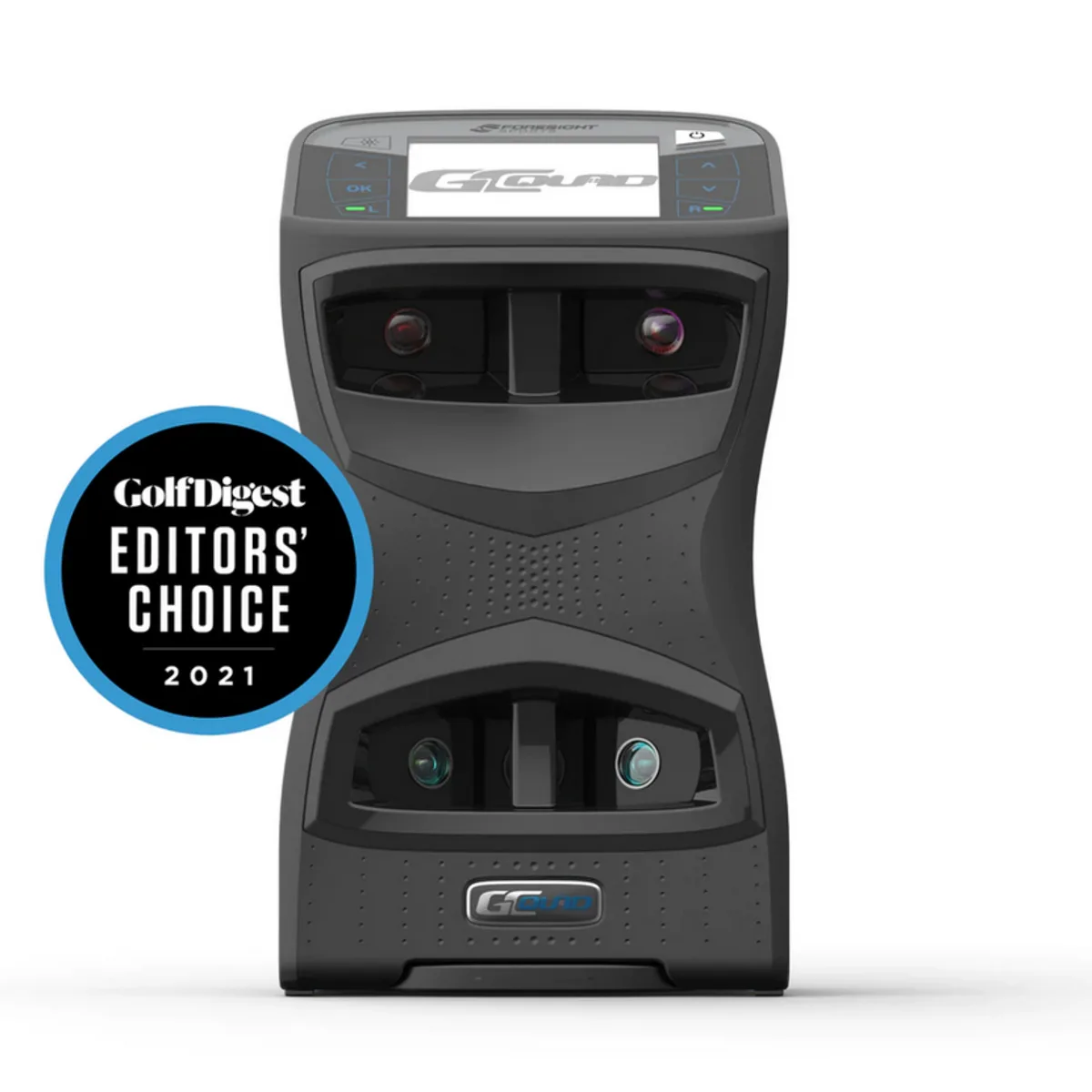
The Foresight GCQuad
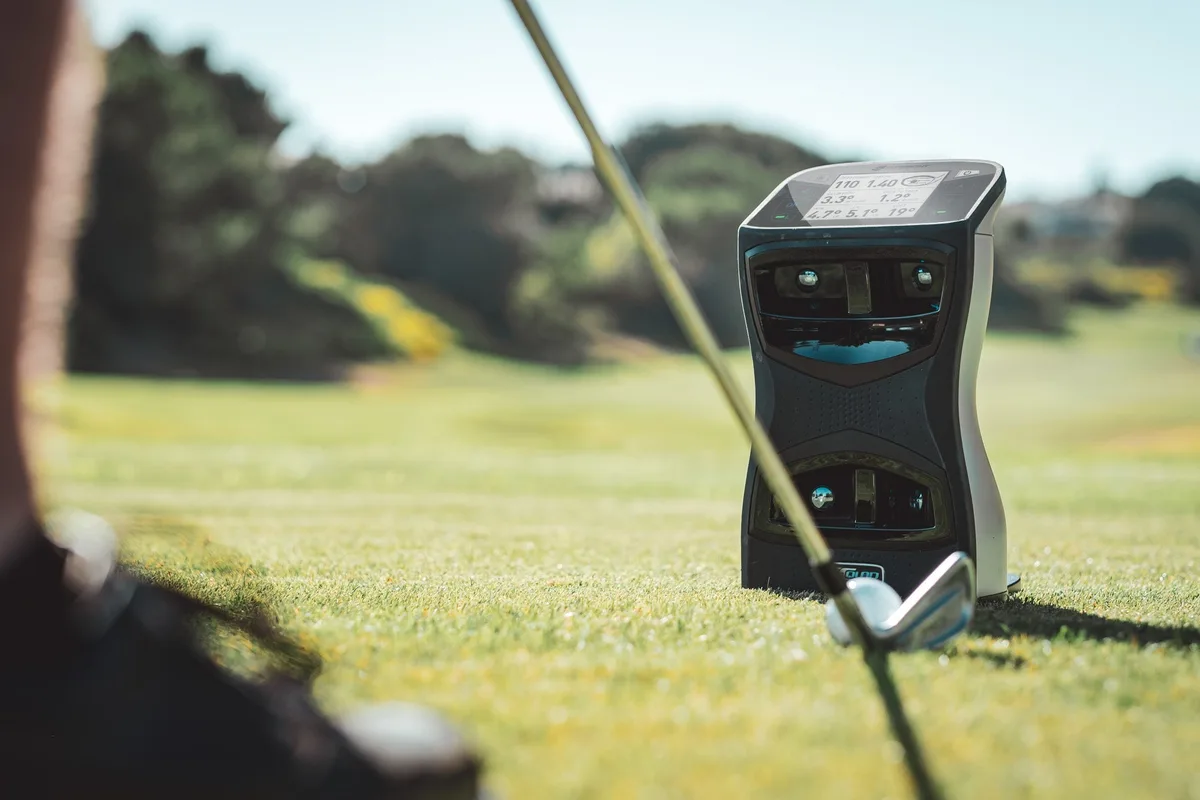
In the wild
The scorecard
Ratings as tested, out of 10.
| Spec | As tested | Caddie's note |
|---|---|---|
| Overall | 9.5 | |
| Accuracy | 10.0 | |
| Value | 6.0 | |
| Ease of use | 9.0 | |
| Software | 9.5 | |
| Price | $11,999 | |
| Brand | Foresight Sports |
what it does well —
- Quadrascopic four-camera system — the most accurate photometric launch monitor ever built
- Club data without fiducial markers. No stickers. No marked balls. Just swing.
- Indoor and outdoor. Transferactive screen readable in direct sunlight.
- Comprehensive data set — ball, club, impact location, face angle, path, all premium parameters
- Three-time Golf Digest Editors' Choice Award winner — industry validation no competitor matches
what to know going in —
- $11,999 is a massive investment — the GC3 delivers 95%+ of the accuracy at half the price
- No built-in touchscreen or battery — must be tethered to a PC and power source
- Form factor is bulky compared to newer units (GC3 is 40% smaller)
- FSX software ecosystem lags behind GSPro and Trackman Performance in simulation quality
- No longer Foresight's newest flagship — the GC4 has replaced it at the top of the lineup
Before the GC3, before the GC4, before the Bushnell Launch Pro — there was the GCQuad.
It’s the launch monitor that changed everything. The first consumer-accessible unit to use four cameras instead of two. The first to measure club data without requiring stickers on your club face. The first to be called “tour-level” and mean it. It won Golf Digest Editors’ Choice three years running. It’s been the benchmark in club fitting studios across the PGA Tour. And in 2026, it’s still a beast.
But here’s the question you actually came here for: should you buy one?
The answer is probably no. At $11,999, the GCQuad is not a good value for most home simulator builders. The GC3 does almost everything the GCQuad does at half the price. The Garmin R50 does the same trick at a third of the price. The Uneekor EYE XO2 matches its data depth for $3,000 less.
But for the people who actually need a GCQuad — club fitters, teaching professionals, commercial sim operators, and the rare enthusiast who demands the absolute best — there is no substitute. It’s the flagship that built the Foresight empire, and it’s still the most proven camera-based launch monitor in existence.
See where it lands in our best launch monitors 2026 guide.
What’s in the Box
- Foresight GCQuad unit
- USB-C cable
- Ethernet cable
- Power cord / A/C adapter
- Alignment tool
- FSX Play software license
- FSX Pro software license
- FSX 2020 software license
- Heavy-duty carrying case
The carrying case is critical. The GCQuad is portable but it’s not pocket-sized. It weighs approximately 5 pounds and is roughly the size of a small laptop bag. It goes from fitting cart to sim floor to driving range without drama, but it’s not something you’d toss in a golf bag (unlike the GC3 which is genuinely packable).
Note for existing GC3 owners: The GCQuad uses the same FSX software ecosystem, so the learning curve is zero. But the data connection is different — the Quad’s quadrascopic system requires more processing power than the GC3’s triscopic setup.
How It Works: Four Cameras, No Compromise
The GCQuad uses a quadrascopic four-camera system. Four high-speed cameras — two for the ball, two for the club — capture every variable in the first 12-18 inches of the swing. Think of it as a forensic reconstruction of impact. The system doesn’t estimate anything. It sees.
The real difference from the GC3 and everything else: no fiducial markers required. The GCQuad reads club data — club path, face angle, angle of attack, impact location, dynamic loft — directly off the club face without stickers. This is a massive advantage for club fitters who swap clubs constantly and teachers who don’t want to sticker up every student’s iron.
From the Foresight site directly: “The GCQuad is the only launch monitor in the industry to utilize Quadrascopic imaging, delivering the most accurate detailed picture of ball and club head performance analysis. With repeatable and reliable data indoors and out.”
The four-camera setup means:
- Impact location mapping — see exactly where on the face you struck the ball
- Face angle at impact — measured directly, not calculated from club path
- Club path in three dimensions — inside/out, but also the vertical plane
- No-sticker convenience — hand any club to any player, get full club data
This is the reason the GCQuad still commands $11,999. No other portable launch monitor does stickerless club data at this level. The Trackman 4 does it with radar ($18,995). The GC4 does it with six cameras ($14,999). But the GCQuad is the proven warhorse.
Accuracy: The Standard Everyone Compares To
The GCQuad’s accuracy is legendary for a reason. It’s within 0.5% of Trackman 4 on ball data and within 1% on club data — and that’s comparing a camera system to a dual-radar Doppler system that costs $7,000 more.
Here’s the data you get:
Ball data: Ball speed, launch angle (vertical), side angle (horizontal), total spin, backspin, sidespin/spin axis, carry distance, total distance, apex height, descent angle, offline distance, hang time, curve.
Club data (no stickers): Club speed, smash factor, club path, angle of attack, face angle, face-to-path, club face closure rate, dynamic loft, impact location (X/Y on face).
The stickerless club data is the killer feature. Every other camera-based launch monitor under $15,000 requires fiducial markers for club data. The GCQuad reads it off the raw club face. This is why every club fitting studio worth its salt runs a GCQuad. A fitting session with marked clubs is a fitting session with compromised data — markers change the swing weight and feel. The Quad eliminates that variable.
In independent testing, the GCQuad produces:
- Ball speed: within 0.3 mph of Trackman 4
- Launch angle: within 0.2 degrees
- Spin rate: within 150 RPM
- Club path: within 0.5 degrees
- Face angle: within 0.5 degrees
These are tour-fitting numbers. They matter when you’re adjusting a player’s lie angle by 1 degree or choosing between two shaft flexes. For a home simulator session where you just want to know if you hit it 285 or 290? The GC3 gets you there for $6,000 less.
Software Ecosystem
The GCQuad ships with the full Foresight software suite:
- FSX Play — Foresight’s flagship simulation engine. 25+ included courses (Pebble Beach, Torrey Pines, Spyglass Hill, St. Andrews, and more). Online multiplayer, skills challenges, practice range, and tournament modes. This is where you’ll play.
- FSX Pro — Professional performance analytics. Track trends over time, run fitting reports, export data. The tool every club fitter uses.
- FSX 2020 — The legacy simulation engine. Still included, still functional, but FSX Play has replaced it as the primary sim experience.
Third-party software support:
- GSPro ($250/yr) — Fully compatible. This is the most popular sim software in the community with 4,000+ user-created courses. Many GCQuad owners run GSPro as their primary sim and use FSX Play for data analysis.
- E6 Connect ($300/yr) — Fully compatible. Solid alternative with a different course library and game modes.
- FSX Live — Foresight’s online league and competitive play platform.
The FSX ecosystem is the biggest weakness of the GCQuad in 2026. FSX Play has improved dramatically since launch, but it still doesn’t match GSPro’s course quality, community, or performance. GSPro runs better on lower-end PCs, has more accurate ball physics, and a more generous licensing model. If you buy a GCQuad, you should budget $250/yr for GSPro — it’s the software the Quad deserves.
Indoor vs. Outdoor
The GCQuad works both places, and that’s rare in this price bracket.
Indoors: The camera system needs about 8-10 feet from ball to screen — less than the GC3 because the Quad’s four cameras can triangulate in tighter spaces. No minimum ceiling height since it sits on the floor. The hitting zone is generous — roughly 10 inches wide by 14 inches deep — larger than the GC3 (7x10) but smaller than overhead systems.
Outdoors: The transflective screen reads in direct sunlight. Take it to the range, hit real balls into a field, and the data quality is indistinguishable from indoor use. This is where camera systems used to lose to radar — the Quad solved it years ago.
Battery: None. The GCQuad must be plugged into A/C power. This is a genuinely annoying limitation for a $12,000 device in 2026. The GolfJoy Spica 3 ($3,200) has a 6.5-hour battery. The Garmin R50 ($4,500) has a built-in display and runs untethered. The GCQuad is the most expensive launch monitor without a battery. That’s a miss.
GCQuad vs. The Competition
GCQuad vs. GC3 ($5,999 — review)
Same family. Different philosophy. The GC3 uses three cameras instead of four, requires fiducial markers for club data, and has no impact location mapping. But on ball data — speed, launch, spin, carry — the GC3 is within 1% of the GCQuad.
The call: If you need stickerless club data (fitting, teaching, coaching), get the GCQuad. If you want tour-level accuracy for your home sim and don’t mind applying stickers to your clubs, get the GC3 and save $6,000. This isn’t close.
GCQuad vs. GC4 ($14,999)
The GC4 is the GCQuad’s successor — four cameras with improved optics, new processing architecture, and a built-in touchscreen. It’s $3,000 more than the GCQuad for marginal accuracy improvements and a newer software stack.
The call: The GCQuad is the wiser buy. $3,000 less for 98% of the performance. The GC4’s improvements are real but incremental. Unless you need the absolute latest hardware for a commercial facility, save the $3K.
GCQuad vs. Trackman 4 ($18,995 — no review yet)
The eternal debate. Camera vs. radar at the highest level. The Trackman 4 uses dual Doppler radar and measures ball flight in three dimensions over hundreds of feet. The GCQuad uses high-speed cameras to capture impact in millimeters. Different approaches, same result: both are within 0.5% of each other on every major metric.
The outdoor case: Trackman 4 wins. Radar tracks full ball flight outdoors. The GCQuad captures impact and calculates flight. On an outdoor range, Trackman’s real-flight data is superior.
The indoor case: GCQuad wins. Radar indoors struggles with the ball-to-screen distance constraint and spin calculation. Camera systems were designed for indoor use.
The price case: GCQuad by a mile. $11,999 vs. $18,995. That’s $7,000 you can spend on software, a better gaming PC, or a year-end vacation.
GCQuad vs. Trackman iO ($13,995 — review)
The iO is Trackman’s indoor-first answer to the GCQuad. Ceiling-mounted, optically enhanced radar, no stickers, no depth requirements. It costs $2,000 more than the GCQuad and requires professional installation.
The call: The iO is the better pure simulator device — ceiling mount means no floor clutter, no trip hazard, no setup. The GCQuad is the better multi-purpose device — portable, indoor/outdoor, fitting-cart ready. Both are excellent. Neither is a consumer product.
GCQuad vs. Uneekor EYE XO2 ($8,999 — review)
The EYE XO2 is Uneekor’s overhead flagship. Ceiling-mounted, dual-camera, impact vision, no stickers required. $3,000 less than the GCQuad. Bigger hitting zone. Better for dedicated sim rooms.
The call: Building a permanent sim room? The EYE XO2 is the better choice — overhead form factor, larger hitting zone, no floor unit to trip over. Need portability, indoor/outdoor, or fitting cart use? GCQuad. The XO2 is a dedicated sim component. The GCQuad is a Swiss Army knife.
Who Should Buy the GCQuad
Buy it if:
- You’re a club fitter or teaching pro who needs stickerless club data and impact location mapping
- You’re building a commercial sim center and need professional-grade hardware that clients recognize
- You run fittings multiple times per week and the GCQuad’s data depth pays for itself in credibility
- You need a portable unit that moves from fitting cart to sim room to outdoor range without recalibration
- You’re a dedicated enthusiast who wants the absolute best camera-based launch monitor and $12K is a business expense
Don’t buy it if:
- You’re building a home simulator — get the GC3 ($5,999) and spend the other $6,000 on your enclosure and projector
- You want a ceiling-mounted installation — the EYE XO2 ($8,999) or Trackman iO ($13,995) are better architectural fits
- You want the newest technology — the GC4 ($14,999) has six cameras and a redesigned processing pipeline
- Budget is a consideration at all — this is a professional tool, not a consumer product
- You want battery-powered portability — the Garmin R50 ($4,499) or GolfJoy Spica 3 ($3,199) go where the Quad can’t
The Final Verdict
The Foresight GCQuad is the most proven launch monitor in golf. It’s been the standard for club fitters for half a decade. The accuracy is unquestionable. The stickerless club data is unmatched at its price point. The build quality is tank-like.
But in 2026, the GCQuad is no longer the automatic recommendation it once was. The GC3 exists and delivers 95%+ of the same accuracy for $6,000 less. The EYE XO2 matches its data depth in a better form factor for $3,000 less. The GC4 is the new flagship (at a higher price). The Quad occupies an increasingly narrow niche: professionals who need stickerless impact data and portability in one package.
If you’re that person — a fitter, a teacher, a commercial operator — the GCQuad is still the right tool for the job. Buy it, abuse it, write it off. It’ll still be running in 2032.
If you’re building a home sim, buy the GC3. The Quad is not a better investment for your garage.
Note on pricing: The GCQuad is $11,999 on Foresight Sports as of July 2026. Street price at authorized dealers may vary. The GCQuad is also available in simulator packages from Rain or Shine Golf, Top Shelf Golf, and Indoor Golf Outlet — typically bundled with enclosures, projectors, and screens at package discounts.
Learn more about the Foresight GCQuad →
Need the right balls for your GCQuad? → Check our Best Golf Balls for Simulator guide
Building a full sim around the GCQuad? → Best Enclosures Guide
Want the full buy vs. wait vs. skip picture? → Best Launch Monitors 2026
Note: Prices are approximate as of July 2026. This review is independent and based on research, manufacturer specifications, and verified owner reports. We may earn a commission if you purchase through links on this page.
Your Next Move.
Where you go from here depends on who you are.