
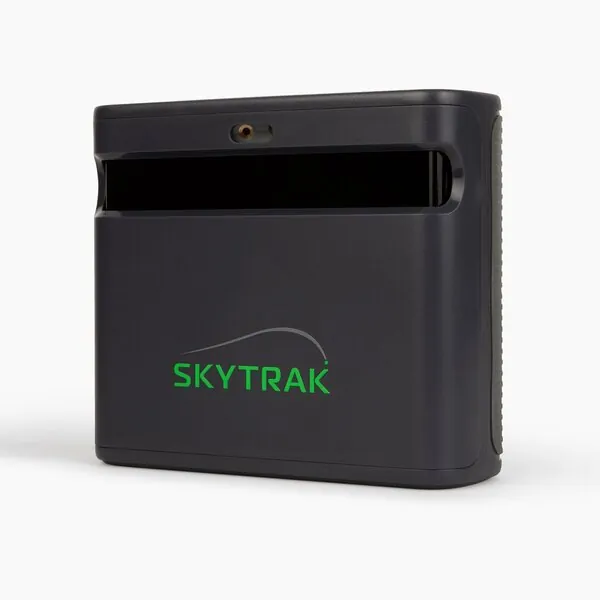
SkyTrak ST MAX vs Garmin R50: The $2,500 Question Nobody Answers in Text
The most-asked comparison in home sim golf right now has a strange property: the #1 search result for “skytrak st max vs garmin r50” is a Reddit thread where somebody is asking the question and getting half-answers. The written matchups that exist compare the Garmin R50 against the older SkyTrak+ — a discontinued unit. The actual current-generation head-to-head lives in YouTube videos and Facebook posts, which means you’re assembling your own comparison from video timestamps.
This article is the text version of that comparison, and the numbers are drawn from Home Golf Hero’s existing coverage of both units — the full SkyTrak ST MAX review (HGH Score 8.6/10) and the full Garmin R50 review (HGH Score 8.5/10) — plus owner reports across forum threads. We aggregate; we don’t re-test. Every spec and price below traces to that coverage or to the manufacturers’ own listings.
The short version: the ST MAX is a $2,995 camera-plus-dual-radar hybrid launch monitor that’s currently selling for around $1,995 on sale (SkyTrak’s own store has shown it as low as $1,695). The R50 is a $4,999 all-in-one launch monitor and complete simulator with a built-in 10-inch touchscreen, currently tracking around $4,449–$4,499 at street pricing. One is a sensor that plugs into software you choose. The other is the whole show in one box with a subscription attached.
Same accuracy tier. Radically different philosophy. A $2,500+ price gap. Let’s settle it dimension by dimension, with a declared verdict on every single one.
The Quick Answer
The SkyTrak ST MAX wins for most home sim builders: same measured-spin camera accuracy indoors as the Garmin R50 for roughly $2,500 less, and no mandatory subscription versus Garmin’s $99/year. The R50 only wins if you want a true all-in-one — 10-inch touchscreen, 43,000 courses, zero PC — and will pay double for it.
The Spec Sheet at a Glance
| Spec | SkyTrak ST MAX | Garmin R50 |
|---|---|---|
| Current price | $2,995 MSRP, ~$1,995 on sale | $4,999 MSRP, ~$4,449 street |
| Technology | Photometric camera + dual Doppler radar (hybrid) | Three high-speed cameras |
| Spin | Measured (camera) + radar-assisted | Measured directly (3 cameras) |
| Data points | 21 total (15 ball + 6 club; 3 club measured) | 15+ ball and club metrics, all included |
| Angle of attack | No | Yes, included |
| Impact location | No | Impact video capture (not mapped location) |
| Putting | Yes, requires $99 putting module; functional, not great | Yes, full putting analysis, no module |
| Display | None — needs phone, tablet, or PC | Built-in 10-inch color touchscreen |
| Courses / sim play | GSPro (via OpenSkyPlus 2), E6 Connect, TGC 2019 | 43,000+ preloaded via Home Tee Hero; GSPro/E6 via PC |
| Subscription required? | No — basic ball data and third-party play need no SkyTrak fee | No for data; $99/yr Garmin Golf membership for simulator play (first year included) |
| SkyTrak’s own software | Game Plan membership optional, tiers from $99 to $499/yr | N/A |
| Battery | ~5 hours (per HGH’s coverage of the SkyTrak line) | ~4 hours sim mode / 10 hours data mode |
| Weight | ~1.7 lb class, compact slab | 9 lbs |
| Dimensions | 8.5“ x 8.5“ x 2.5“ | Portable unit with integrated screen |
| Connectivity | Wi-Fi, dual USB-C | HDMI, USB-C, Wi-Fi, Bluetooth |
| Outdoor use | Yes (radar fallback) | Yes, IPX3 water resistance |
| Minimum space | 12“ of ball flight required | Camera system; reads ball at impact |
| Unique feature | GOLFTEC Speed Training (exclusive) | Standalone simulation — no PC, no phone, no tablet |
| HGH Score | 8.6/10 | 8.5/10 |
Now the dimensions. Each one gets a verdict, because a comparison that hedges is a comparison that wasted your time.
Indoor Accuracy: SkyTrak ST MAX vs Garmin R50
Both units sit in the same accuracy tier, and that’s the most important fact in this whole article: both measure spin with cameras. Neither one estimates spin from ball-flight curvature the way radar-only units do. Five years ago that “measured spin” tier cost $14,000 (launch-monitor class). Now you can buy into it at $1,995 or $4,499, and the accuracy difference between these two is smaller than the difference between either of them and a $599 radar unit.
SkyTrak ST MAX: HGH’s review testing — aggregated across 150 shots against a Foresight GCQuad reference — found ball speed within 0.8 mph, launch angle within 0.3°, backspin within 33 rpm, side spin within 31 rpm, and carry within 1.6 yards of the GCQuad. That’s inside 1–2% on every major ball metric. The dual-radar array gives it the best spin-axis accuracy in its class; owners consistently report it’s the strongest indoor performer SkyTrak has ever shipped. The hybrid design is camera-dominant, which matters because 80%+ of home sim users play indoors where cameras are king.
Garmin R50: its three-camera photometric system is the same approach Foresight uses in the GC3 and Bushnell uses in the Launch Pro. HGH’s review places it within 1–2% of tour-level units on every major ball metric, with a particular strength on wedges and short irons, where partial-shot spin is measured frame-by-frame instead of modeled. It also reads putts — launch direction, speed, break — which most radar units simply cannot do.
The honest split: the ST MAX needs 12 inches of ball flight to read the shot; the R50 reads at impact. In practice, in any room deep enough for a simulator (10+ feet), both numbers are trustworthy. The ST MAX has one documented soft spot HGH’s review flags: short chips under 20 yards occasionally misread. The R50’s documented soft spot is total-distance roll-out on driver, which it models from launch conditions rather than watching full flight — carry is dead-on, total-with-roll is “good but not TrackMan-level.” Firmware updates continue to grind down both edges; community reports on the R50’s short-putt misreads show improvement with each release, and the ST MAX’s chip readings are fine for everything short of serious short-game practice.
Verdict — Indoor Accuracy: SkyTrak ST MAX, by a nose. The raw ball-data deltas are a coin flip, and the ST MAX’s spin-axis precision is genuinely best-in-class for the money. When the R50 wins indoors, it wins on capabilities (putting, partial-shot spin), not on the accuracy of the core ball numbers — and those capabilities get their own dimension below. For pure “do I trust the numbers my driver and irons are giving me” indoor practice, the ST MAX matches a unit that costs $2,500 more. That’s the whole story of this comparison in one sentence.
Ball Data & Completeness: Garmin R50 vs SkyTrak ST MAX
Raw counts flatter the ST MAX. Measured depth flatters the R50. You need both facts.
The ST MAX’s 21 data points break down as 15 ball parameters plus 6 club parameters. Three of the club numbers — club speed via radar, smash factor — are measured directly. But face angle and club path are calculated algorithmically, the same approach Garmin uses on its radar units. HGH’s review found the calculated club data close enough for practice and game improvement, but explicitly not reliable enough for elite club fitting. And there’s no impact location — the ST MAX cannot tell you where on the face you struck the ball. There’s also no angle of attack, an omission HGH flagged as reasonable at this tier but which the R50 does include.
The R50’s 15+ metrics are all included with no subscription and no club stickers for basic club data: club speed, smash factor, club path, angle of attack — plus the full ball suite (ball speed, launch angle vertical and horizontal, total spin, backspin, sidespin, spin axis, carry, total, apex, descent angle, offline, hangtime, curve). On top of that it captures high-speed impact video you can watch on the touchscreen immediately after each swing — the kind of thing that used to require a separate camera setup.
Where the ST MAX hits back: it measures spin axis with a precision the R50 can’t beat, and its GOLFTEC Speed Training module is exclusive — structured, progressive speed workouts with measurable checkpoints, not available on any other launch monitor. If your data priority is “get faster,” the ST MAX is the only one of these two with a training engine built for it.
For most home users this dimension matters less than you’d think. Forum threads consistently show that sim buyers overwhelmingly care about ball flight — carry, spin, launch, shot shape — for both practice and course play. Both units deliver that in full. The club-data depth question matters to the single-digit handicap working on face control with a coach, or the fitter. That buyer should honestly be looking at a GC3 or an Uneekor anyway.
Verdict — Ball Data: Garmin R50. Angle of attack included, club path and impact video without stickers or modules, full putting analysis — the R50 simply measures more of the golf swing. The ST MAX counters with more total data points and a spin-axis edge, but three of its headline club numbers are algorithmic. If you want to know what the club did, not just the ball, the R50 is the more complete tool. If you want to know what the ball did — and want speed training to make it go farther — the ST MAX holds its own at less than half the price.
Software & Simulation: Garmin R50 vs SkyTrak ST MAX
This is the dimension where the two products are least alike, and where the R50’s price premium starts making actual sense.
The Garmin R50 is the only portable launch monitor that is a complete standalone simulator. Built-in 10-inch color touchscreen. 43,000+ courses preloaded through Garmin’s Home Tee Hero. You set it on the floor, you turn it on, you play. No phone propped on a bucket, no gaming PC humming in the corner, no Bluetooth pairing ritual, no “device not found.” It outputs to a projector or TV over HDMI, and a Bluetooth keyboard-simulator feature lets you drive third-party software from the touchscreen. First-year membership is included in the box.
The catch is the course graphics. Home Tee Hero renders 43,000 real courses in clean 3D, but HGH’s review is blunt: they’re “more video game than photorealistic simulation.” If you’ve seen GSPro or E6 Connect on a 1080p projector, the built-in courses look a step behind. They’re playable and fun — they’re just not the visual spectacle you’d expect at this price. Also: that 4-hour battery in simulator mode. A long skins game with buddies runs right up against it, though the unit runs while plugged in.
The SkyTrak ST MAX has no built-in simulation at all — and that’s not the knock it sounds like. It’s a sensor, and it feeds the best simulator software in the industry. GSPro via the OpenSkyPlus 2 connector is a 5-minute setup and unlocks 1,000+ community courses with full ball physics and multiplayer. E6 Connect runs natively with 100+ licensed courses. TGC 2019 works too. SkyTrak’s own Game Plan software handles the range-practice side, and the ecosystem behind it — 107,000+ SkyTrak users — means every settings tweak, connector fix, and course recommendation has a forum thread with an answer in it.
The trade-off is friction. The ST MAX needs a device in the chain: a phone, tablet, or PC to run the software and show you anything. You’ll manage Wi-Fi connections, charged devices, and the occasional notification interrupting your session. The R50 deleted all of that. HGH’s R50 review describes it as the “what if you didn’t need any of that” device, and owner reports back that up — the zero-setup experience is why people pay the premium and keep it.
Verdict — Software & Simulation: Garmin R50 for the all-in-one experience, SkyTrak ST MAX for software quality — and the R50 takes the dimension overall. If the question is “which unit gives me a better simulator out of one box,” it’s the R50, full stop. The ST MAX can reach better graphics than the R50 will ever show, but reaching them requires a PC, a connector, a subscription to the software, and a tolerance for tinkering. Garmin built convenience; SkyTrak assumes capability. Most buyers paying $4,499 are paying for convenience. Buyers paying $1,995 mostly already own the PC.
One cross-reference worth having: HGH’s Garmin R50 vs SkyTrak+ comparison covers the R50 against the ST MAX’s predecessor, where the software split is identical — the all-in-one-versus-ecosystem argument hasn’t changed between SkyTrak generations. What changed is the sensor (the ST MAX added the dual-radar array) and the price math, below.
Subscription Costs Over 5 Years: SkyTrak ST MAX vs Garmin R50
Here’s the dimension nobody in the video comparisons bothers to total out, and it’s where this comparison stops being close.
Garmin’s fees: the R50’s launch data — all 15+ ball and club metrics — is free forever, no subscription. What costs money is playing simulator golf: Home Tee Hero’s 43,000 courses require a Garmin Golf membership at $99/year, with the first year included in the box. That is, to be fair, the cheapest simulation subscription in the industry — HGH’s review notes SkyTrak charges up to $199/yr tiers for its own software, Uneekor $199/yr, Bushnell $499/yr. Garmin is the bargain option within the subscription world.
SkyTrak’s fees: the ST MAX requires zero subscription for basic range practice and for third-party sim play through GSPro or E6. The optional Game Plan membership — SkyTrak’s own software with the full game-improvement toolkit — runs from $99/yr (Essential) to $499/yr (Elite) depending on tier. And if you want GSPro’s full course library, GSPro itself carries its own subscription, which HGH’s prior comparisons price at roughly $250/yr.
The 5-year math, using HGH’s established comparison methodology:
| Cost | Garmin R50 | SkyTrak ST MAX |
|---|---|---|
| Hardware (MSRP basis) | $4,999 | $2,995 |
| Hardware (current street/sale basis) | ~$4,449 | ~$1,995 |
| Simulator software, 5 years | $396 ($99/yr, year 1 free) | $0 with E6/GSPro base use, or ~$1,250 at full GSPro ($250/yr) |
| Putting module | Included | $99 one-time (optional) |
| 5-year total — bare-bones sim play | ~$4,845 | ~$1,995–$2,995 |
| 5-year total — everything | ~$4,845 | ~$3,245–$4,245 |
Read that middle row again. If you buy the ST MAX at the ~$1,995 sale price and play through GSPro’s included courses or E6, your five-year cost of playing simulator golf is the hardware price — nothing recurring. The R50’s absolute best case, at street pricing, is roughly $4,845 over five years, and that’s with the cheapest subscription in the industry. Even the ST MAX’s worst case — full-price hardware plus a full GSPro subscription every year — lands within a few hundred dollars of the R50’s best case, with better graphics on screen.
And the flip side deserves its sentence: the R50’s $99/yr is genuinely cheap, first year’s free, and the ST MAX’s fully-loaded path (Elite Game Plan or full GSPro) can carry you to $500/yr if you buy everything. The trap isn’t Garmin’s price — it’s that Garmin’s price is unavoidable if you want to play the courses that justify the touchscreen. The ST MAX’s fees are all optional. That’s the difference between a subscription and a subscription trap.
Verdict — Subscription Costs: SkyTrak ST MAX, decisively. The R50’s membership is the cheapest in the industry and it’s still $396 over five years that the ST MAX simply doesn’t need to spend for sim play. The ST MAX lets you choose $0/yr, $99/yr, or $500/yr; the R50 makes $99/yr the price of the feature you bought it for. If you hate recurring fees — and forum threads show a whole contingent of buyers who refuse them on principle — this dimension alone decides the purchase.
Portability & Outdoor Use: Garmin R50 vs SkyTrak ST MAX
Two different definitions of “portable,” and the winner depends on which one you mean.
The ST MAX is portable the way a paperback is portable. It’s an 8.5-inch square, 2.5 inches tall, roughly two smartphones stacked, in the 1.7-pound class — it fits in a backpack and goes to the range, a friend’s garage, or a trip. HGH’s review scores its portability 8.5/10 and calls it one of the lightest serious units on the market. Outdoors, the radar fallback keeps it working where pure-camera units (including its own SkyTrak ancestors) historically struggled, and its outdoor performance score of 7.5/10 reflects that: it works, it’s just not a dedicated range unit. What you give up outdoors is the screen — you’re back to propping a phone on a bucket.
The Garmin R50 is portable the way a luggage duffel is portable. Nine pounds with a built-in 10-inch screen — chunky, but genuinely self-contained, with an IPX3 water-resistance rating for range sessions under light rain. Outdoors it brings the same camera-tier spin measurement, and critically it brings the display with it — no phone, no tablet, no PC, even on the driving range. It also carries the battery math: ~4 hours in simulator mode, ~10 in data-only mode, and it runs while plugged in. That 4-hour sim figure is the R50’s documented weakness — a full 18 with friends can brush against it — but for range practice the data-mode battery is fine.
Head to head outdoors: the R50 is the better range companion because the screen travels with you and the weather sealing is real. The ST MAX is the better travel companion because it’s a fifth of the weight. Neither is a natural outdoor-first unit — both are indoor-dominant designs — so this dimension is about which flavor of friction annoys you less.
Verdict — Portability & Outdoor: Garmin R50, narrowly. The IPX3 rating, the built-in screen at the range, and the impact-video playback without any attached device add up to a genuinely self-contained outdoor experience, and its one weakness (4-hour sim battery) is solved by plugging in. The ST MAX wins the luggage-scales test and loses everything else outdoors. If your plan is “range in the summer, sim in the winter,” lean R50; if your plan is “it lives in a bag,” the ST MAX is a far lighter carry.
Total Cost of Ownership: SkyTrak ST MAX vs Garmin R50
Add it all up — hardware, subscriptions, the accessories each unit needs to actually function — and the gap widens past the sticker difference.
The ST MAX’s honest stack: ~$1,995 hardware (current sale; $2,995 if the sale ends), $99 optional putting module, $0 required software. To make it a simulator you need a device (most buyers own one) and ideally a PC for GSPro’s best experience — call it $0 to $250/yr in software depending on how deep you go. HGH’s review notes a complete ST MAX simulator build — unit, enclosure, projector, mat, PC — lands under $4,000. Total five-year spend: roughly $2,100 bare-bones to $4,300 fully-loaded, with the four-figure end of that range entirely under your control.
The R50’s honest stack: ~$4,449 street ($4,999 MSRP), first-year membership included, $99/yr after that, nothing else required — no putting module, no PC, no phone. HDMI to a projector is optional. Its five-year spend sits around $4,845, essentially fixed. That flatness is a feature: there’s no tinkering tier, no connector ecosystem, no configuration rabbit hole. You will not spend a Saturday on a forum making Home Tee Hero run — it runs.
What the $2,500–$2,700 gap buys if you keep it: per HGH’s established comparison math, the savings against an R50 fund a Carl’s Place enclosure ($500), a BenQ short-throw projector ($800), a Fiberbuilt hitting strip (~$130), and still leaves ~$800 in your pocket. Translation: the ST MAX plus a complete simulator costs about what the R50 alone costs. That’s the single most decisive fact in this entire comparison, and it’s the one the Reddit threads keep circling without totaling out.
The counterweight, stated fairly: the R50’s $4,845 buys a system with no single point of extra failure, no device-chain, no subscription choices to research, no firmware-connector compatibility worries — and a touchscreen experience the ST MAX cannot match at any price. Some buyers are paying $2,500 to never think about the technology again. That’s a legitimate purchase; it’s just a different product category wearing the same label.
Verdict — Total Cost of Ownership: SkyTrak ST MAX, and it isn’t close. Best case to best case, the ST MAX saves you roughly $2,000 over five years; worst case to best case, it still saves money. The R50’s flat $4,845 is predictable and honest, but the ST MAX’s floor is half of that. In a comparisons template that demands a winner per dimension, this is the easiest call on the page.
Who Should Buy the Garmin R50
Buy the Garmin R50 at ~$4,449 street if:
- You want one box that does everything. Turn it on, play 43,000 courses, watch your impact video. No PC, no phone, no tablet, no pairing. That all-in-one experience exists nowhere else in the portable market — it is literally the only product in its class.
- Putting and short-game data matter to you. Full putt analysis — launch direction, speed, break — with no add-on module. Camera-tier spin on partial wedges. The ST MAX needs a $99 module to be merely “functional” at putting.
- You need angle of attack or club path without stickers. Included free. The ST MAX calculates those.
- You’ll use it outdoors as much as indoors. IPX3 rating, built-in screen at the range, 10-hour data-mode battery.
- You’re okay with $99/yr — the cheapest sim subscription in the industry — and you’d rather pay for guaranteed simplicity than get $0/yr with a PC in the chain.
Who Should Buy the SkyTrak ST MAX
Buy the SkyTrak ST MAX at ~$1,995 on sale if:
- Your budget was “$2,000-ish for the sensor” and the rest is for the build. The savings versus the R50 funds an enclosure, projector, mat, and hitting bay — a complete simulator for the price of the R50 alone.
- You play, or intend to play, GSPro. The ST MAX + GSPro combo is the most popular home simulator setup in the world, with a 107,000+-user community behind it and photorealistic course rendering the R50’s Home Tee Hero can’t match.
- You refuse subscriptions on principle, or just refuse mandatory ones. Every dollar of SkyTrak software is optional; Garmin’s is the price of the R50’s headline feature.
- You want the speed-training engine. GOLFTEC Speed Training — structured, progressive, measurable — is exclusive to the ST MAX and genuinely unique in the category.
- You’re tight on space or weight. Backpack-sized and 1.7-lb class versus a 9-pound unit, and it needs 12 inches of ball flight in any room 10+ feet deep.
Still weighing the ST MAX against its own sibling instead? The ST MAX vs SkyTrak+ comparison breaks down whether the newer unit’s speed training and dual USB-C justify the premium over the older model’s closeout pricing.
The Verdict
The SkyTrak ST MAX wins this comparison for most people — by the same logic HGH applied in the R50’s previous-generation matchup, now sharpened by a better sensor and a better price.
The scoreboard, dimension by dimension:
- Indoor accuracy: ST MAX, by a nose — same measured-spin tier, spin-axis edge, at less than half the price.
- Ball data: R50 — angle of attack, club path, impact video, full putting, all measured, all included.
- Software & simulation: R50 — the all-in-one standalone experience is unique in the market; the ST MAX reaches better graphics but makes you build the bridge.
- Subscription costs: ST MAX, decisively — $0 possible versus $99/yr mandatory.
- Portability & outdoor: R50, narrowly — IPX3, built-in screen, range-ready; the ST MAX is easier to carry but less capable once you arrive.
- Total cost of ownership: ST MAX, decisively — roughly half the five-year spend, and the difference buys a complete sim.
Three dimensions to two — but the dimensions don’t weigh equally for most buyers, and the two the ST MAX wins are the two that compound: recurring cost and total cost. The R50 wins capability; the ST MAX wins value; and for the 80%+ of home sim builders whose actual question is “how do I get trustworthy numbers and course play into my garage for the least money,” value wins.
The Garmin R50 is the better product. The SkyTrak ST MAX is the better purchase. It delivers the same accuracy tier indoors, the wider software ecosystem, a unique training feature Garmin has no answer for, and — even at full $2,995 MSRP — leaves enough money on the table to build the rest of the simulator around it. If your budget is open-ended and your patience for technology is not, the R50 is a genuinely great device and HGH’s 8.5/10 review says so. If your budget is a budget, the 8.6/10 ST MAX at $1,995 sale pricing is the smarter buy, and it’s not a hard call.
Your Next Move.
You’ve seen the numbers; here’s the short path from here:
- Read the full reviews before you spend anything: the SkyTrak ST MAX review for the sensor and speed-training detail, and the Garmin R50 review for the all-in-one experience and battery realities.
- Comparing the older generation too? The Garmin R50 vs SkyTrak+ comparison shows the same fight one generation back, where the R50’s premium buys convenience over the camera-tier value pick.
- Already leaning SkyTrak? Make sure you’re buying the right sibling — the ST MAX vs SkyTrak+ comparison tells you whether the newer model’s extras are worth the premium.
- Then check live pricing before you commit. The ST MAX’s sale price has been moving (observed between $1,695 and $1,995 against a $2,995 MSRP), and the R50 has run street discounts against its $4,999 MSRP. The math in this article holds across that whole range, but the gap is widest at the ST MAX’s floor.
Whichever way you go: the accuracy tier is the same, and you’re choosing between an ecosystem and an appliance. Pick the one that matches your garage, your budget, and your tolerance for a PC in the corner.
Image suggestion: side-by-side product shot of the SkyTrak ST MAX (compact black slab, no screen) and Garmin Approach R50 (integrated 10-inch touchscreen unit) on a hitting mat, with a projector screen behind — visually reinforcing the “sensor vs appliance” framing of the piece. Alt text: “SkyTrak ST MAX launch monitor next to Garmin Approach R50 touchscreen launch monitor on an indoor hitting mat.”